Tuesday, January 15, 2019

Button Books: What to buy?


Some of my books in my button room.
When it comes to books, I have no SHELF control!

Button Books:  What to buy?

ISBN thinking about you... *grin* (yes, there will be book puns!) You know button collecting is terrific. We all start a button collection for various reasons. Some of us just are interested in the pictorial or design. Perhaps you just want to collect buttons, any and all!  To many button lovers, age and material doesn't matter. There isn't anything wrong with this method of collecting...Until you start to ask questions about what you have. 

So, you get on the computer, and look at photos of buttons... and try a zillion key words.  *ugh*  And if you're like me, you look like this:


So, you started collecting and (sooner or later) are ready to CHECK OUT because you want to know MORE. WHAT is that material? WHEN was it made? WHO wore that?  IS this one really a button? WHY is that picture on that button! WHY is this shank so different looking!!!? WHY do they call it THAT?

WHY is that (little, ugly, weird, etc.) button SO FREAKING EXPENSIVE!!?? 

WHYYYYY?  LOL

The first few years I collected, I didn't have much of an idea about the National Button Society nor button clubs.  Information on the internet was zippo... nada.  I was basically floating along on my own, hoarding all the buttons I could find at swap meets, antique shops and 2nd hand stores.  Then, my husband bought me my first button book while on a vacation celebrating our anniversary.  The book was About Buttons by Peggy Ann Osborne.

With just that one book, the switch was flipped and I was learning about these tiny treasures. It is still is my favorite book of all time, and one I recommend to any new collector.  The book is around $80.00 new, but IMHO, well worth the cost.  This book answered lots of questions and made me want to know even MORE, MORE, MORE!!  So, as I could, I added more button books (and got myself to go see a button club).

Today I'll share a few favorites in my Button reference library with you, and give you my take on what's great about the books, what I feel is a must have, what you can live without (or at least wait until you find it at a bargain price).

The #1 spot is tied.  There are 2 books that I have dog eared, fallen asleep with and would chase someone down with my pointy button awl to get them back:

#1a:  ABOUT BUTTONS: A Collector's Guide, 150 A.D. to the Present.  Peggy Ann Osborne, 1994.  320 pages, colored illustrations.  I ADORE this book.  My copy is worn and tattered and I slept with it for months after buying it.  It takes you through various periods and explains the buttons that were worn at the time, along with slices of history and beautiful photos.  All books have errors, it's BOUND to happen, but this one is pretty on the money.  If I had to pick only one button book, this one would be it.


Closely followed by...

#1b:  Big Book of Buttons (BBB):  Hughes-Lester; First Edition (June 1981)  813 pages. Called the Button Bible by collectors, this book separates buttons out by material and then by pictorials.  I have my face in this book at least twice a week. While it's difficult to look up buttons in to identify something, if you read this book from cover to cover, you'll get a good grasp on how the National Button Society classifies buttons and you'll be seeing terrific buttons and some decent identifications. The BBB 1st edition has identification errors, and went out of print.  The old editions can be terribly pricey, as high as $500!!  Crazy!

The BBB was updated and reprinted in 2011 into 2 volumes (which makes it easier to read/handle) and was updated some. It sells for $375.00 plus $18.00 shipping.  I'm not sure it's worth it, so... if you can find an old copy of the BBB for $100-$250, I'd recommend to buy it (and use that extra $$$ for buttons!)!  You can always sell the old version for what you paid for it if you decide to buy this new updated version. If you love the old pictorial metal buttons, and want to know what the identifications/names were that they generally go by, then you really will want this book. I like big books and I cannot lie.

#2 The Collector's Encyclopedia of Buttons, Sally Luscomb.  242 Pages, 1968.  A forgotten older book, however, packed with lots of information.  Revised in 2007 and includes a price guide (ignore that) .  A great book to curl up with and absorb all the great information and button lingo/jargon. 

#3 National Button Society Classification Booklets:  Well, this isn't actually a book, but more like a booklet... and there are several that you should have.  Start off with that I really (REALLY) think you should join NBS, if only for the booklets and on line searches available to you through ALL of the NBS bulletins that were digitized and made searchable by keywords.  You can read all of the old bulletins starting from 1945 onward.  I LOVE their website for that reason, and I use their booklets constantly. 
Well worth the $35.00 yearly membership since you get all the access AND five (5) issues of the National Button Bulletin which is in color (fabulous every issue!) along with the Classification "Blue" Book with information on classifying buttons and also competing (if you wish to eventually do so).  
With membership, you can also purchase numbers 4, 5, 6 and 7 below:

#4 Black Glass Classification
(just updated by Joan Lindsay and Simone Kincaid, 64 pages and 800 color photos, and it's WONDERFUL!!)  $25.00 A must have for a new collector since black glass is one material you'll amass a ton of quickly!!  Great photos, information on both the old (Division I) and modern (Division III) buttons. Available on the NBS website (link above and below).


#5 Clear and Colored Glass Classification by Jane Ford Adams and revised by Jean Longo.  Revised in 2002, with wonderful information and color photos, 30 pages, $8.00.  Again, glass is going to flow into your collection quickly, so you might as well get this great booklet to get a handle on old and new glass.  Terrific photograph and lots of information which tells you about the old (Division I) and modern (Division III) buttons.  In color. Available on the NBS website (links below).


#6 Pearl and Shell Button Classification by Margaret Kelso and updated by Shirley Case in 2002.  Shell is wonderful and this is also a great 26 page booklet packed with photos and information.  $8.00.  Available on the NBS website (links below).


#7 National Button Society Section 9-A Synthetic Polymers by Jocelyn Howells and Nikki Deal  A complete study of all Plastics (except Celluloid).  A must have booklet!  Color photos and everything you need to know about those hard to identify and confusing plastics.  You'll be a pro at sorting Polyester from Nylon in no time! A BARGAIN at $5.00! Available on the NBS website (links below).


#8 Button Materials A-Z: Identification Guide, Jocelyn Howells.  $55 includes shipping. Everything you'll need to figure out what a button is made of. Order direct from the author buttonjoss@frontier.com 


Now, there are 100's of other button books. Some out of print, but can be had dirt cheap on eBay, Amazon and book sites like Abe Books. 

IMHO, the following books are also worth having. So, Check your shelf before you wreck your shelf.. Do some comparison shopping first, and get these super, mostly inexpensive books for the great photos, info and just a good book to sit with:

Buttons: The Collector's Guide to Selecting, Restoring, and Enjoying New and Vintage Buttons; Courage Books, 1994 by Fink & Ditzler

Baubles, Buttons and Beads The Heritage of Bohemia; Schiffer, 1997 by Jargstrorf, S.  Super information on the early Bohemian/Czech button industry with beautiful pictorial examples of Beads, Buttons and Jewelry (what's not to like!?).

Button, Button: Identification and Price Guide: Identification and Price Guide; Schiffer, 2000 by Peggy Ann Osborne. I truly adore this author's books! See my #1 books above.  And by the same author... Fun Buttons; Schiffer, 1994 by Peggy Ann Osborne. I spotted one on eBay for less $8!! 


Antique and Collectible Buttons: Identification and Values; Collector Books, 1997 and Antique and Collectible Buttons: Identification and Values, Volume II; Collector Books, 2002 - both by Debra Wisniewski. Fun buttons that most new collectors can easily find.

Buttons by Epstein & Safro; Harry Abrams, 1991. Hardcover, 175 pages, color (don't get the tiny book!). A Gorgeous book filled with rare and wonderful buttons.

Now, if you would rather spend your money at button shows, eBay and ETSY *grin*, you can always BOOK it over to your local library! Also, join a local button club! They usually have a lending library and you might also get a free button mentor/button buddy just for hanging out with them! 

And if you're wondering how many button books there are (including crafting with buttons, military, written in other countries/foreign language, uniform, etc.) there are book lists at several websites you can use to look at button books that may also feed your button soul:

WESTERN REGIONAL BUTTON ASSOCIATION BUTTON BOOKS BY TOPIC

BUTTON IMAGES BOOK LIST

NATIONAL BUTTON SOCIETY STORE (no, I don't make any money on links!) You can purchase several of the booklets listed above here AND join NBS!

Thanks for reading today! I hope you'll follow my blog (yes, I've been neglectful!) as I have plans to do all kinds of fun and informative button posts soon!  I hope you'll follow the FBR blog and leave me a comment!

ALSO be sure to wander over to my FLYING BUTTON RANCH facebook page! I post there a few times a week. Lots of fun stuff going on there also (so be sure to Like and FOLLOW the page)!
I hope you've had a GOOD READ here and that these book puns have tickled your SPINE. Okay! I'm done!!
Happy Reading and Buttoning!


Thursday, December 17, 2015

BEETLE MANIA

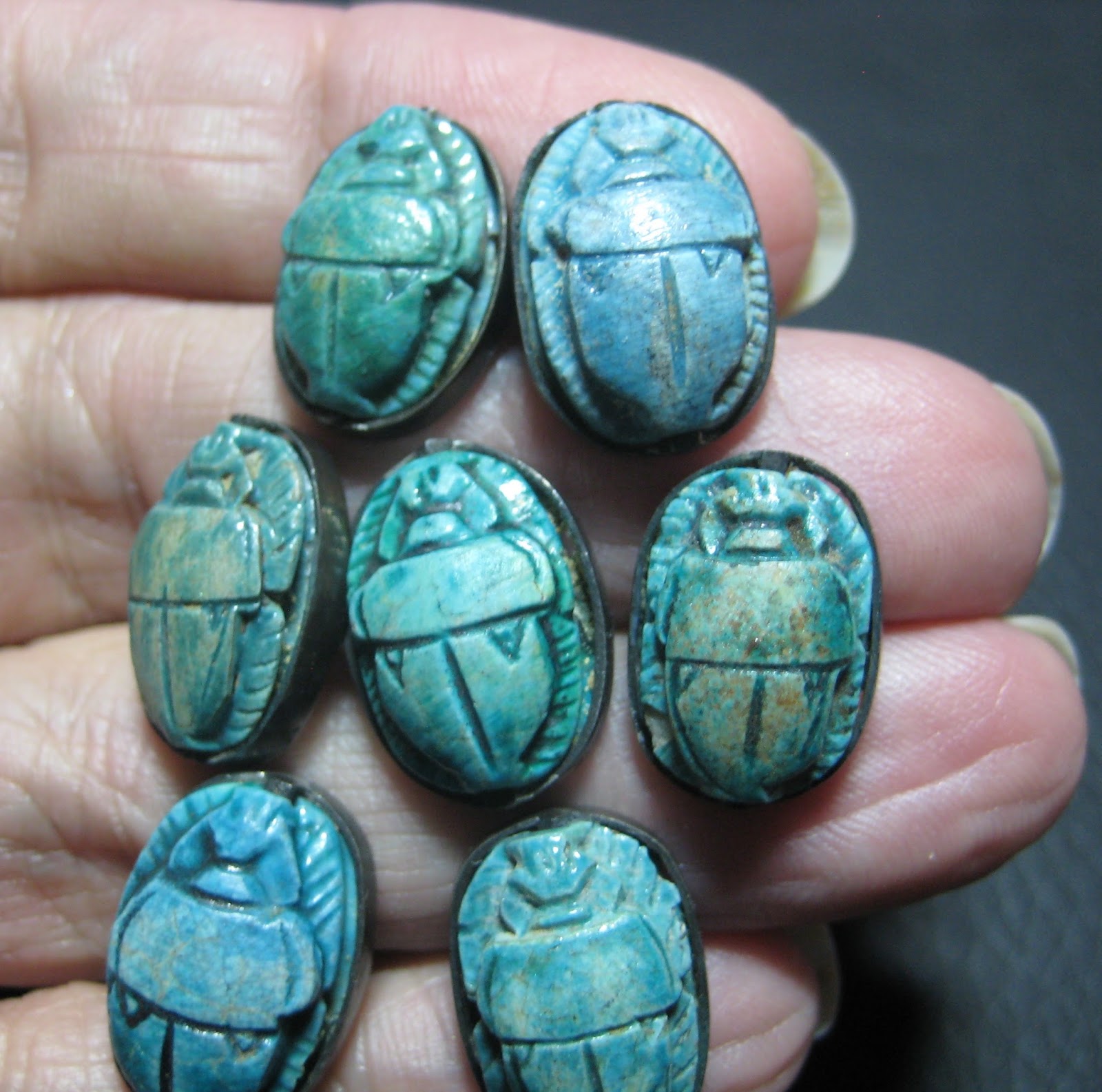
These buttons are KHEPERS (keepers)! *grin*
Meet the Beetles!  
These sweet little lovelies are Egyptian SCARAB BEETLES and are mounted in silver. What a great find at the antique show I went to last Saturday! I calmly and politely bargained for them. I put on a poker face, trying my best to act uninterested... seeming ready to pass them back and walk away (never!!) as I made a final offer...and was victorious.  

Yes, I admit it... I did a little happy button dance walking away from that table clutching my prize! My husband acted like he didn't know me for 5 minutes. LOL


They are a Dung Beetle, which is an ARTHROPOD and scarab comes from the taxonomic family name, Scarabaeidae.  This video about blew my mind... pretty interesting if you have an interest in these bugs!

These odd beetles spend their days flying around (yes, they have wings!) searching out piles, forming and rolling balls of dung backwards with their hind legs.  Yeah... doodie, poop, number 2!! The dung is not only their food source, but they will roll the ball to put under ground in a burrow where it then lays an egg in it, which keeps the egg warm due to composting action. 
Mom!  Herman isn't playing ball with meeeeeeee!
The egg incubates in the warm crib of caca known as a brood ball, hatches and then the single offspring eats it while in larvae form until ready to molt and emerge from the nest, fully formed and ready to fly away to carry on the tradition. 

"Hey kids! Dinner's ready. I don't care what you think it tastes like! Just eat it.!"   I should remind my husband about the dung beetle next time he complains about having to eat leftovers.  At least it's not the same **** every day.  haha... 

BEETLE MANIA


An Egyptian Scarab beetle is also known as a Kheper, which is an Egyptian PUN (and we all know how I love a good pun!). 

The Egyptian word kheprer means both scarab and "to exist or become" and to the ancient Egyptians, the strange insect was associated with word the due to their other worldly sudden appearance out of the earth. 

The beetles were worshiped by the Egyptians and became an important symbolic figure of creation and resurrection akin to the cross and its symbolic meaning for Christians, Almost everyone wore the symbol of the scarab in one form or another as an amulet worn around the neck on a cord or string or tied to the wrist or a finger.  

The scarab beetle was often depicted with a sun overhead since like the sun, the beetles appeared and disappeared each day. They also believed the dung beetle kept the Earth revolving just like a giant ball of dung they rolled underground, linking the insect to Khepri, the Egyptian god of the rising sun who was believed to control the movement of the sun.

The Egyptian god Khepri, (also derived from the same word Kheprer) was considered the god of the sun, creation, life and resurrection and like the scarab, like the scarab, he was believed to also be self-existing (appeared on his own and not created by anyone or anything).  

He is usually is depicted as a human with a scarab beetle on his head or with the head of a scarab beetle. Like the scarab, Khepri was believed to push or roll the sun along the sky each day, just as the Scarab pushes along his "special" cargo and food.  The little beetles do in fact, follow the sun for guidance in navigation to their burrow.  

The scarab was used as an important Egyptian symbol before 2000 BCE and continued well beyond the the last Pharaoh ruling Egypt.

Hmmm, a bug and a guy with a bug head who have coprophagia (your FBR word of the day... gah!) and then you want to become a big fan boy of that guy and the bug? The early Egyptians weren't the sharpest crayons in the box I think.  LOL

THIS OLD BUG

When you thinks of Egypt, the pyramids, sphinxes, mummies, and the scarab amulet are probably the first objects that come to mind.  Okay, and maybe the movie Raiders of the Lost Ark and Indiana Jones flashed in mine for a second or two and to be honest, the Bangles song Walk Like An Egyptian song became a brain worm for a day. DOH!  *shrugs*

The scarab has been collected for centuries, with the most interest for them starting in the nineteenth and early twentieth centuries as drawings of the wonders of Egypt started to appear after the first European explorers reported their findings.  Before the 19th century, travel from Europe to Egypt was difficult and almost unheard of. In 1799 Napoleon's expedition drew attention to the treasures of Egypt.  Exploration of 1845-45 and documentation started the desire for all things Egyptian and the Egyptian Grand Tour era was born.

Archaeological and antique Egyptian treasures were both a popular tourist item and the small scarab amulet pieces were brought back or imported in order to sell to collectors and were often incorporated into jewelry (and occasionally buttons and studs). Egyptian design became highly popular all through the 19th century when the first Egyptian Grand Tour era was in full swing during the late-Victorian era.  Many antiquities, but especially small scarabs, were brought back from Egypt because they were so plentiful back then.

The interest in all things from Egypt really ramped up again when in 1891 British archaeologist Howard Carter started searching Egypt again, even though most of the ancient Egyptian tombs had been discovered.  

The little-known King Tutankhamen, who had died at the age of 18, was still unaccounted for and shortly after World War I Carter started an intensive search for King Tut’s Tomb. On November 26, 1922 he and a fellow archaeologist (Lord Carnarvon) found and entered the amazingly intact tomb. The interest in the story and news of the found treasures greatly and quickly influenced design. Jewelers such as Cartier, incorporated faience, scarabs and other Egyptian made pieces in fine pieces of Egyptian inspired jewelry around that same time.
Scarabs have fascinated the amateur collector for well over a century.  Interest in the little amulets in beetle form heightened when in 1917 W.F.M. Petrie published a now classic guide which is most often referred to by collectors.  Scarabs and Cylinders with Names not only has become the reference for scarab collectors, but also by those who wish to deceive collectors and use it to produce forgeries. 

There are scarabs which bear the names of kings, the royal family and names of officials, of which are carefully and artfully carved on the reverse in both raised or intaglio carved hieroglyphs.  Much in the same way that coins show the changes in a civilization, the reverse of a scarab can provide a method of dating them and applying their historical place in Egypt.

THE BUTTONS

When I saw and purchased the buttons, I just assumed them to be a glazed ceramic or Egyptian faience. Faience is an odd material, and is made from sintered finely crushed silica (a finely crushed quartz), plant ash and copper oxide.
Back view of silver shank.  The bar connecting the bezel obscures the carving on the bottom.
It isn't really a pottery, but is the earliest known NON-CLAY ceramic composition (similar to Prosser china buttons in a way). It was a precursor to glazed clay-based ceramics, such as earthenware and stoneware, and also to glass (which wasn't invented until around 3500 BCE). It was made to mimic precious stone (lapis and turquoise) and can be found in a wide range of shades of turquoise, blue and green, though the oldest found usually has a glaze that has mostly turned to a brown color. Water was mixed with the crushed paste mixture to make it moldable and as it dried, the water and alkali migrated to the top of the piece, bringing with it the copper oxides which self glazes the piece as it is fired and creates a vitreous hardened surface as the alkali fuses with the quartz and copper. 
ANCIENT FAIENCE HIPPO WITH BROKEN LEGS WHICH SHOWS THE QUARTZ PASTE BODY
Tuesday I started off what would become a looooong day doing research on Egyptian scarabs. I figured I was on the right track ROLLING IT around in my head *grin*, that all scarabs were made of Egyptian Faience. Right?
An ancient molded faience Scarab

W R O N G
*SIGH*
While there are faience scarabs, everything started to indicate that the buttons I found were made of glazed carved STEATITE (a mineral talc occurring in a consolidated form, or as it's more commonly known as SOAPSTONE) once I started reading about the history of the scarab.

Both the earliest Egyptian scarabs (antiquities, beginning around 2040 - 1786 BCE ) and modern antique scarabs were carved from steatite and then they were glazed with copper or cobalt based glazes that were fluxed with plant ash and fired to give them their beautiful glossy blue and green colors and also fuses with the steatite and creates a hardened surface in the same manner that the glaze did on faience material.   

Glazed mineral or stone!?  Wow.  Well, I certainly learned something new!  I didn't even know that glazing a mineral was even possible!!
Range of colors in the set of buttons.  So pretty!
One clue that you have steatite is that you won't see fine sharp molded details (as with a ceramic or glass) and when you have a set, it's easy to see that they all are carved just a bit different. 


The glaze makes it difficult to identify just what the material is made of (and I was only about 80% sure about these being glazed soapstone by this time). So to be SURE... I emailed an expert who is a collector of early Egyptian Scarabs and seals who lives in Germany. 

I told him that they were in a (tarnished) silver setting, and that the scarabs were each drilled at each long end. There was a sharp point from the silver bezel setting holding the scarab cab in the setting by being inserted into the holes at each end.

I also told him that I thought they were probably soapstone/steatite, and that I figured they were put in the silver settings during the Egyptian Revival period, around 1920, though I had no idea of the age of the scarabs themselves.  I also said that I would value his time and opinion since I wanted to write about these, and wanted to provide correct information for anyone who would care to read about them, and also so I could categorize the material and age correctly in my collection.  I offered to send photos as an email attachment if he cared to see them.  He replied fairly quickly and told me to send photo attachments.  

This was is reply late yesterday:

Hi Vicky,

Thanks for your Email and the pics. I think you are perfectly correct with a date around 1920. They are not antique in terms of archaeology but certainly older than 50 years in my opinion.

They look as if they are coming from the same workshop or even were made by the same hand. However the stuff coming from modern workshops in Egypt does not reach this quality.

Material seems to be glazed steatite and at least on one example I can see a stylized Amun-Re inscription with flanking Neb signs (=lord) so the inscriptions seem to make sense, which nowadays is not always the case. The shape is inspired by 19th Dynasty scarabs (roughly 1300-1200 B.C.) They were probably made when Egyptology reached it's height of popularity in the 20s or 30s. Older examples from the 19th century are known as "Grand Tour scarabs" These are sometimes hard to distinguish from the originals. Authentic Grand tour scarabs are carefully made, often glazed and mostly have a readable inscription, often copied from illustrations in Petrie or Newberry. You can find examples on the internet but the term is often used to sell modern forgeries especially on ebay. 

For a button collector your scarabs must be very interesting, thanks for sharing them

Best Wishes and Merry Christmas
Olaf
(if you'd like to have a look at his website and pieces from his collection, it's really fascinating! )

So there we have it!  Not ancient antiquities, however the scarabs older than the settings, and they're glazed steatite.  The markings he noted on the back of each scarab are interesting, but unfortunately, the setting blocks viewing them for the most part.

Olaf also sent me a link to a scarab from the last century BCE which was in a setting from the Victorian period to show me the difference between a true scarab antiquity brought in during the Egyptian Grand Tour and set into jewelry to compare with I have. The very early scarabs are very finely carved and finished.  He warned me though, that there are many forgeries of these out there that mimic these ancient scarabs. You can see the lovely piece here:

Modern scarabs, especially those in the last 50-80 years which are imported for jewelry, beading or crafting usually aren't hard to distinguish.  They are a bit boxy rather than oval and the top is flatter (rather than rounded top shell).  Details, especially the head and legs just aren't carved well on most of these. 
Modern scarabs sometimes sold as old.
A BUTTON SCARAB as called by scarab collectors, is actually a SCARAB AMULET. They LOOK like a button fastener, but are NOT.  They were also worn, suspended by a drilled hole through a formed hump area on the bottom of the scarab and a thread or cord was threaded into the hole and it was tied on as a necklace, on a wrist or finger. Many of these amulets found today are fakes, made to look like the ancient ones in order to deceive scarab collectors, and may pop up in button collections or for sale as a button once in a while. 
AMULET CALLED BUTTON SCARAB.  BACK VIEW.  NOT A BUTTON!!

ANOTHER BUTTON SCARAB AMULET
Resist buying those with these "self shanks" that are thick and usually have lined carving on them. One of these was mentioned in the NBS bulletin Sept. 1955 as a button, in a collection.  Ugh! A bonus though, if a true antiquity (and not a later forgery) it could be worth a bundle of money!!

When a scarab cab is set in metal or has more of a typical button style self or inserted metal shank, you can be assured that it was meant to be used as a button.

Keep a look out for a lovely real beetle shell set in metal button also! It's NOT a scarab (as sellers like to identify it as), but a Brazilian or Ecuadorian beetle known as a Cassidinae or TORTOISE BEETLE from the Chrysamelid family. It's a leaf beetle with a beautiful iridescent shell that makes for a wonderful button, just not as scarab beetle example!
Photo from Pinterest
Scarabs have had several eras of design popularity and when one shows up on a button, pricing on them usually is stiff, so snap up bargains quickly! 

A set of six jeweled gold-mounted Nephrite scarab buttons marked Fabergé, Moscow, 1899-1908.
Sold at Christies auction for $50,602.00
Fun group of scarab and Egyptian theme buttons found on Pinterest, noted as sold on eBay for $124.95.
They're always a popular pictorial for button collectors and it would take a while to put together a whole varied tray of them because they aren't terribly common, especially Division I scarab examples! Both Division I and Division III (modern) eras have scarab pictorials in a variety of materials such as ceramic, plaster, carved stone and gemstone, glass, enameled metal and modern plastics. There are also a few fabulous metal scarab buttons to be found. 

Scarabs, beetles and other bugs are fun to search for on buttons and are probably one of my favorite pictorials (next to Dogs). 

I was pretty happy to be able to bring these guys home AND it was a birthday gift to myself.  I'm tellin' ya...on the way home from the antique show, I could hear all 7 of the little beetle buttons singing "Crappy Birthday toooo Yoooouuuuuu!" from inside the bag, I swear it!!
.   

Wishing you and yours a Merry Christmas and a buggy button New Year from myself and Luna the Wonder Chihuahua here at Flying Button Ranch.

FBR xx

Saturday, August 15, 2015

A Jaw Dropper in the collection - Coquilla Nuts - ODD but Wonderful!

Once in a while, a button comes to us that makes our jaw fly open *grin*  As I was sorting the 100's of loose buttons from the collection I bought locally, I couldn't believe my eyes when I grabbed this button, it was one of *those* jaw droppers:


Note the twisted brass wire at 3:00 on the button holding the carved beads to the metal rim.


And the construction?  Amazing!


R i g h t?  *grin*

Well the thing that really got me going were those wired BEADS!


It was the beaded border that had me a bit unsure.  After I reset my jaw, I wondered for a minute if they were vegetable ivory, but that didn't seem quite right by the way they looked.  There was a difference in color in the beads, especially one in particular (see above) that reminded me of something, but I couldn't put a finger on it.  It sat on a card as I pondered it for weeks...

Then I remembered!  

COQUILLA NUT!  (pronounced Ko-Kee-Ya)

I WILL explain! *grin*
It's not a button construction you'll see used often, and you may not have ever even heard of these types of beads or nuts, but its use was well documented during the early 1800's for a variety of items and was used in manners very similar to what we call vegetable ivory for buttons.  

The Coquilla Nut is South American and is in fact the fruit from a Brazilian Palm.  It is also closely related to the coconut palm and is used like the slightly smaller vegetable ivory nut that is called Corozo.  There are 6 different varieties of palms that have similar nuts. The oval nut is larger on the Coquilla, about 3 to 4 inches long, and has a very hard, richly streaked brown shell that is capable of taking a fine polish.  

A COQUILLA NUT AND AMBER BEAD NECKLACE

The nut of the Coquilla was used for a variety of highly ornamental popular items,, usually with "Turnery" carved, and drilled designs.

Victorian Coquilla Nut Thimble Cases

The following is an excerpt from The Repository of arts, literature, commerce, manufactures, fashions and politics by Ackermann, Rudolph, 1764-1834 says this about Coquilla Nuts:

"The uncommonly pleasing colour of the  shell, the hardness and the native mottle which appears when it is highly polished, renders it capable of being employed, with the most agreeable effect, as it is susceptible of the most tasteful forms — on the writing-table, in wafer-boxes and seals, pounce, sand-boxes, &c. — on the ladies’ work-table, in needle-cases and thimble-cases, cotton-boxes, pincushions, &c. — or on the toilette and dressing-table, in boxes for lip-salve, rouge, scented sponges, and every kind of pomade. In the form of egg-cups, the nuts will be found to decorate the eating ‘table. 
As bell-pulls, they are very elegant.  As they appear to great advantage when worked up into beads, rosaries, and crosses, they will, doubtless, give a pleasing variety to personal decoration, when shaped into necklaces, bracelets, ear-rings, and other trinkets. Little useful pocket articles, as nutmeg-graters, cases for smelling-bottles, and other similar portable conveniences ; in short, whatever has been formed from ivory, may be produced from the shell of the Coquilla, whose beauty will not fail to attract, while the price of the article will satisfy the purchaser.”"

(the entire book is on line, free at HERE)

More wonderful information about Coquilla Nuts to give you an idea about the natural nut's look and more can be found at the Nutmeg Graters (dot) com website HERE.

So... Vegetable Ivory is actually Coquilla nut!?  They look very similar.  Yikes!! But really, it's ALL Vegetable Ivory, just a different species with a slightly different size fruit/nut. Buttons embellished with these carved beads aren't plentiful and are usually wired or riveted on to the button.


A hand-full of wonderful!


So... This lovely button is definitely an oldie (Div I), and a large size,  The beautiful wood appears to be Rosewood and is slightly lipped.  The wood face holds the stamped metal design face by attached pins which go through the wood and are curved back flat on the back of the button through the bar shank.

The bar type shank stretches from the metal outer curved metal border piece which cradles and holds the wired beads on.  It has a soldered brass metal loop shank.  A complicated and wonderful construction!

I have a bit more research to do on this one to make 100% sure it's Coquilla (UPDATE - I'm sure it IS). Unfortunately, this boxing up of the house to put it on the market and getting ready to move in December/January is interfering with my buttoning AND writing in this blog!! LOL


I'm also going to try to do a bit of searching to find out WHY this woman has her hands inside her Obi sash.  LOL  Is that socially acceptable? *rolls eyes*  Does she stash her cookies there so her kids and her husband can't find them? Bwahaaaaaaaa  That's what I'D DO with my obi

Seriously, I'd like to know if she is a Geisha?  A Courtisan? A story character or famous figure of some kind?  You know me... always curious what the story is BEHIND THE BUTTON.

*grin*

SO... I just wanted you all to see this jaw dropper now, even though I don't have much info. on her yet, and also just to drop a little bit of Coquilla Nut information on you!

Oh, and don't forget to go over to the Flying Button Ranch Facebook page.  I try to post something about buttons every day!  It's keeping me SANE.  Please LIKE and FOLLOW my Facebook page for button posts and updates on new Flying Button Ranch Blog posts!  (Don't forget to check the SEE FIRST box!).

Feel free to share links to this blog on your website, Facebook page or Button Club page!

Question?  Comment?  Please post or contact me through this blog or on the FBR Facebook page!
Until next time! <3 FBR
P.S.  A quick update:  Thanks to Jackie Douglas of Toronto for emailing me to tell me that she spotted this button is in the 1977 book Buttons - A Collector's Guide by Victor Houart on page 83!! “button of Japanese inspiration...brass on a black metal background surrounded by beads in boxwood. 1880-1890. “   How lucky am I that she just got that book!?
I confess, I NEVER look in that book!  Why?  Mr. Houart is a GENERAL collectible's author (his books include those on Antique Spoons, Miniature Silver Toys, Easter Eggs, Sewing Accessories), and doesn't really have much to offer about buttons (IMHO), so after the first look through, it just went on the shelf with all the rest of my button books.  BUT... I ran upstairs to my button books, and sure enough *tah dah* there she was!  I don't think Victor got the bead material right, or it was made from different beads at different times perhaps?  Mine doesn't have a black metal background like he mentions either (maybe that was in error on Mr. H's part due to the b/w photo?), and he doesn't give a clue as to the size of the button that is shown in his book. Regardless, much thanks flying out to Jackie.  It was fun to see a grainy photo of this button in a book, and I still think it's a rather scarce button, BUT I'll keep looking to see if I can find more!  'Till next time! <3 FBR