Thursday, May 21, 2015

There's a Place In France... (Part 1)

The title to this month's blog?  Yeah...Sorry about that... No naked French ladies dancing here, so if that's what you came in for... move along).  That's just the school yard song I kept hearing while I was trying to figure this button out (well, my head song was the cleaner version with Alligators I swear!) LOL! Now, it's a brain worm I can't get rid of... *sigh*

I am trying to figure out a place in France though!
Yet another button that makes me go HMMMMMMMM.
Welcome to another button mystery that is bugging me.  I hate not knowing WHY something is on a button. Sometimes you just know it's just decorative or an artfully expressed design and nothing more.

Sometimes you just know it's something just a bit more special.  Pictorial buttons can be fun and interesting.  When I get one, I want to know if a button is a famous person, a place where something famous happened or if it is a commemoration of sorts of some special period in time.

But first... Let's start with a quiz!  What do you see on this button?
We'll talk more about the above button, and see how you did at the end of the blog.

Back to the Hmmm portion of this blog.  Today I'm trying to figure out these big beautiful buttons which feature a Lion in the design.


As they looked when they came out of the mail box.
I was searching the Interwebz for more interesting Lion buttons for my collection after recently purchasing a wonderful large brass Lioness head button.  I had never seen these buttons before, so had to have them!  I felt lucky they were on their way to Arizona.

I waited impatiently as the set of 5 traveled to my home in Surprise, Arizona all the way from Rueil-Malmaison, France.  They are a whopping 2" in diameter.

Side view. Two pieces. Very thin base, thick, reverse pinned molded decorative top piece.
Brass swaged in shank.
Yes!  Swag and Swedge are an OLD button term used by manufacturers
Most surprising was the unusual color differences/changes between all 
5 examples, both on the backs and the back.
One button was really light colored on the back, 

while the remaining 4 were dark, almost black.

Front color compared to back (original) color.
Note the arrow under the Lion's feet.  Symbolism?!  Great molded detail on this button.
These have a 2-piece construction.  The large top decorative Lion is pinned with 2 metal pins through the reverse.  The back is shiny, the fronts were a bit scratched and were more of a matte when compared to the backs. They seem light for their extra large size.

Did you know?  The Lion has been a common emblem to symbolize bravery, valor, strength and royalty.  After all, the Lion is known as the King of Beasts. 

WHAT I DO KNOW

A brass metal version of this same Lion design is shown on Plate 106 (#11) page 276 of the (old version) Big Book of buttons as:

A Brass stamped in high relief, applied to a one piece, concave button which has a horizontally ribbed surface.  Applied steels form a sunburst behind the lion and a border under the tablet.  The whole is suggestive of a piece of statuary, with the symbolic olive and palm branches below. Scarce.  $35.00 (a hefty price 1981!).

The metal button also shows up in Viviane Beck Ertell's book The Colorful World of Buttons on Plate 28, but nothing is noted about it at all.  I've jumped through loads of my old button books (which are great for browsing, but terrible to locate anything).  Nothing that looks remotely like my French lovelies.

So I search the Interwebz.  I found the same scarce metal button I saw in the BBB currently being offered for sale for $450.00 from Robin Larner at her Etsy site.  I messaged her and she's given me permission to use the photo so anyone without a Big Book can see him (and maybe buy him!) and we can compare the design.  Thanks Robin!
What a gorgeous metal button!
Image courtesy of
(and Copyright by) RC Larner.


Hmmmmm (and more hmmmm).  Well, my buttons obviously are not metal, but they are the exact same face design as the molded brass Lion (minus the cut steels).  I can't help but think that my group of 5 are also very scare buttons, maybe even more so due to the odd (non-metal) material.  I have a good idea what they are.  More on that, later...

I also start to think that a positive identification as statuary was truly lacking back in 1981 when the description was first written in the BBB.  I'm also really surprised that the button wasn't identified as any specific place by the early collectors who seemed eager to identify picture buttons in the early years of button collecting.

The description wasn't changed in the new edition of the BBB.  I called a friend to confirm it, since my new copy isn't here yet (well, because Mr. Handbasket hasn't asked me what I am buying myself for our Anniversary in June yet *evil grin*).

I remember the very common button that pictures the Lion of Lucerne.  Seems that you can't grab a handful of buttons in a poke box and not get one.  This button causes more measles for new collectors who put it on a competition tray as an animal.  The measle (competition disqualification) is received, because the Lion of Lucerne is pictorial representation of a MONUMENT/STATUE (Section 20-1, Architectural Structures/Scenes) and is not an animal/Lion. Once you get a competition measle for using the Lion of Lucerne, you'll never forget what this button is (ask me how I know.... L is for Lion?  No, L IS FOR LOSER!  LOL).


The Lion of Lucerne.  Lucerne, Switzerland.
This mortally wounded Lion commemorates the Swiss Guards who were massacred in 1792 during the French Revolution.  It is said to be the most beautiful and moving piece of stone in the world.
It's a great story!  Go Google it or at least find what Mark Twain said about it.
Antique metal button picturing the Lion of Lucerne.
Move this button away from your animal cards and 
to your Architectural Structures card RIGHT NOW!  
Go on... I'll wait for you.  LOL!
 Since I think my buttons will be similar to the Lion of Lucerne... that's where I start, looking for statues.  So... off I go to do some research.

I *HEART* GOOGLE

Yes, I love you Google.  I can't imagine having to leave my house, go slog through the Library and try to find information.  You make my button collecting exciting and research fun.  I find buttons from around the world that I would have never known about without YOU.  Consider this my official thank you (and I won't go into what I don't like about you today. *grin*)


Did you know?  If you type "Tilt" or "Askew" into the Google search box and hit return, it will give you a tilted page view.  Yup, go do it (or torment a co-worker by leaving it on their computer screen). *snickers*


I Got A Bad Case of the Googles  

Well, I know they flew over to Arizona from France (and boy, are their arms tired! OW!  OKAY! I'll stop!) and the seller wasn't a button collector, so I doubt that they started off life in the United States, so the country of France is where I think I need to start my research.  I start with some simple keywords:

1)  Lion, Statue, France - I search pictures first:  Yikes.  Lions with water squirting out of various orifices, hanging out in city centers with Pigeons on their head and people taking photos with them. I think there is a Lion statue or fountain in each city of every country.  I scan through them all to see if I can find something that looks a bit similar in the way the Lion is sitting.

And BINGO! There he is!  Well, it's not a statue, it's a MONUMENT, well, monumental SCULPTURE!

"Do these little people make my butt look big?"


Note the arrow under the paw, just above the year.

Le Lion de Belfort (The Lion of Belfort)

Well, that was quick!  For a change!  LOL!!  Now to get some info on it.

This massive and fierce looking work of art is symbolic of the French Resistance against the Prussians during the grueling 103 day Prussian assault of the city of Belfort at the end of the Franco-Prussian war.  This period is known as the Siege of Belfort (December 1870 through February 1871). With only 3,500 military fighters, the city was outnumbered by the 40,000 invading Prussians. Approximately 14,000 civilians joined in the battle to protect and save their city.  Belfort only surrendered the city when they were finally directed to do so by the French government.  It was one of the few cities which remained French whereas other parts were annexed to Germany.

The pink sandstone sculpture was designed by renown artist, sculptor, and former officer during the Franco-Prussian War, Frédéric Auguste Bartholdi.  

This beautiful monument to the siege was conceived during a period where the city of Belfort (located in North-Eastern France, near the border of both Germany and Switzerland) was still occupied.  The city council wanted a small monument to be erected at the cemetery to recognize those who had lost their lives.  Bartholdi, a native of Colmar, who's native region was annexed, was greatly affected by the occupation and annexation and was enthusiastic about the project, though he had a slightly grander vision in mind for the monument.  He envisioned a Lion carved out of the Citadel that would be "harassed, cornered and terrible still in its fury."  His design was accepted, money was raised, and the design underwent several changes so that it would depict "energetic defense" rather than convey glory or defeat due to the occupation at the time.

Originally designed to face East to Prussia, the monument was actually constructed to face in the opposite direction after German protests.  In 1880 it was completed and it watches over the city of Belfort symbolizing the strength and pride of its citizens.  Today, as it was then, it is a major attraction for visitors.

Frédéric Bartholdi is probably best known for his design of our own symbol of American freedom, Liberty Enlightening the World (or as we all know it today, The Statue of Liberty).
Frédéric Bartholdi, the Statue of Liberty and the Lion of Belfort.  
Bartholdi died in 1904 in Paris of Tuberculosis.
I also searched through the NBS website's copies of the Bulletin and looked for any reference to Belfort (none) and the Lion, and also through all Just Buttons issues they have (also zippo).

THE LION BUTTONS

Well, I'm left to my own devices here.  LOL  IMHO the buttons probably date anywhere from 1875-1910.  It's possible that they were made during the period of time after the conception of the design/when construction started and the cost of the monument required major fundraising, so perhaps items like the buttons were made for sale to raise money.  The Belfort monument was completed in 1880, and there would have been interest in commemorative pieces and for the enterprising button manufacturers there was money to be made from the image (1880-1910).  It only makes sense to date the buttons as Division I, like we already know their metal cousins are.

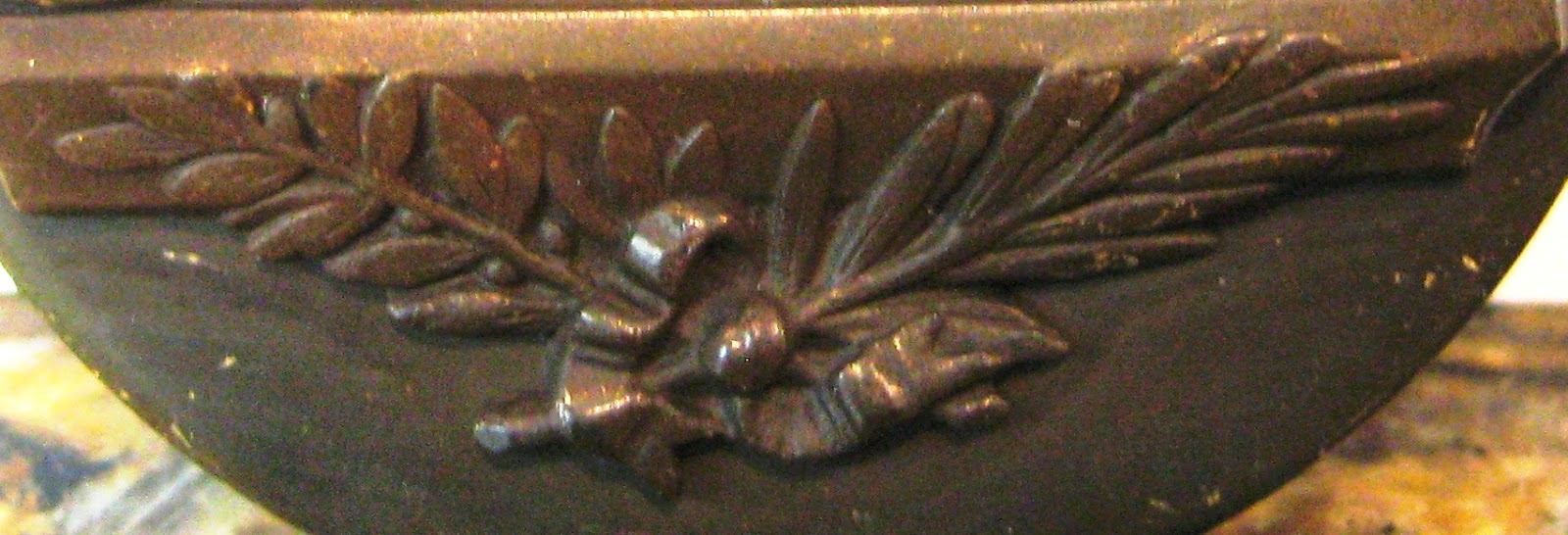
The button's design actually shows the Lion on a plinth (block or stone supporting a statue, pillar, etc.).  Another interesting thing I noticed is that the branches of leaves under the plinth appear to be two different types of plant.  Upon magnification, you can see that one is Laurel (symbol of glory and victory) and one is Oak (symbol of wisdom and long life).  I looked up the various National Emblems of France and the Laurel and Oak branches were used during the French Third Republic from 1870 until 1940.  It changed briefly from 1940-1944 and then they were again incorporated in a slightly different designs and both continue to be used today.

It just goes to show you, one shouldn't take a MARBLEOUS pictorial button for GRANITE... (get it?  Marble?  Statue?  Granite?  OW!  OKAY!  I'll stop!).

So, my Lion buttons will be classed as 20-1 Architectural Structures and/or Scenes and as a Statue or Monument button, and NOT as an animal/Lion.  I think that now when I look at a Lion button, it will give me PAWS for thought if it could be a statue, sculpture or monument. *Runs Away*


Rats!  So, they won't be living with my pride of other Lion buttons or be used on any animal trays! Okay, I can live with that... after all, I'd say these were still quite a find.


But what are they made of?  

*scratches head*
This is my least favorite part of research.  It is so easy to get it wrong when something is black or brown.  I have a pretty good idea, so next time, we'll talk MATERIALS of the era, and I'll consider each of the common moldable materials available during the period of time that I believe they were made along with photos of other known buttons, testing and the *exciting* conclusion.

In the mean time... Do you have a guess?  What do YOU think they are?  Leave a guess in the comments section.  Maybe you have this button?  If so, I'd LOVE to hear about it!

So, there we have it.  A new name for a newly found version of a scarce button (The Lion of Belfort - well, that's what I'm calling them from now on!).  I confidently place them as Division I (pre 1918), the same as their metal cousins shown above.

Gotta love that there is another button that now that is identified as to the reason for the pictorial, a place, time (and soon, the material), though some of you may not love that this button will now also get a measle like the Lion of Lucerne if used on an animal tray.  Sorrrreeeeeeey LOL

Time for the Quiz answer.  Did you know what that button was?  Well, don't feel bad.  I had a hunch after thinking about the Lion of Belfort, and of course, looked up this button too.


Yup, an architectural structure.  But which one?  The Lions of Ashoka, or the Lion Capitol (the uppermost part of a column) of Ashoka.  It was originally placed atop the Asoka pillar at the Sarnath by Emperor Ashoka in 250 BCE and is now in the Sarnath Museum.  The capitol design is actually of four Lions, but of course, only 3 can be seen at one time....  Yeah...  Isn't this FUN?


Button collecting, oh the places these small treasures will take you!  Seems I trip down new roads and reinforce some things I had forgotten each time I add a new unusual button to my collection.  Today I learned a little more about a Country I have (yet) to visit (it's on the Bucket List!) and I learned something new about a time in history that I probably slept through (or ditched) in History class.

I also reminded myself that what you see on a button may not be what you think you are getting! *rolls eyes and signs*  But, remember, they're YOUR buttons, and you can display them how you want to.  However...If you want to compete at button shows...you need to know this stuff!

If you made it this far, thanks for reading!  Feel free to share this blog's URL and give links to button clubs, FaceBook and forums.  Got a button question?  Interested in collecting buttons?  Looking for a local button club to join?  Find an old button and want more information?  Just ask!  Always happy to help.

Hope to see you back for Part II when I'll still be going through the process of identifying the material of the Lion of Belfort.  I'll be looking at closely at the buttons, talking about the materials of that time period, smelling (and maybe tasting them!  yeah...) and share all the steps I use to identify them. Care to join me?  I have a testing job for you... guess which one.  LOL.
Cheers,
Vicky 
P.S.  Yup, Hellen is gone, and I'm BAAAACK!  By the way, if you bookmarked my blog, the url has changed!

P.S.S. Did you know that an angel came down to earth once and gave two statues a wish?  They chose the gift of life for 30 minutes.  The two statues went behind the bushes for 15 minutes, and after much rustling about came back out smiling.  The angel told them they still had 15 minutes left.  One statue asked the other if they wanted to do it again.  The other statue said "Sure, but this time you hold down the pigeon and let me crap on it's head!"

P.S.S.Ssssss If you were interested in the Wooton Buttons, I've updated it several times with more pictures of some new Wooton buttons (thanks to many Button Bytes members).  If you follow my blog by email or Google Plus (up above and to the right of the blog) you'll get notices of new posts and updates.

Friday, April 24, 2015

A RARE BUTTON BEAUTY? THE RASPBERRY RACE OF THE VELOCIPEDES


I never was a big one for Victorian metal picture buttons. Plenty have come my way over the years, and well... they're usually just okay.  That said, I like to add buttons to my collection that are odd and unusual and have a little weirdness. Kind of like me!  LOL  Usually, a button that has an interesting material tends to grab my attention (and my wallet) first.

I trip through the interwebz and auctions searching for fun things for my collection on lazy mornings when Cinderella (the name I gave my Neato robotics vacuum) is buzzing around on the floor doing my bidding and my work for me and Luna the Wonder Chihuahua is taking a nap in my lap.

A few weeks ago, while feeling particularly lazy and looking for some button fun, I came across this Large size, raspberry tinted beauty, almost hidden in the group of other antique buttons it was piled in with.

Large, 1-1/2"
WOW what is that?  A bicycle?  Nope, it has THREE wheels.  A TRICYCLE?  Hmmmm.  
Some buttons just make you go HMMMMMM.
This lovely button is a whopping 1-1/2" in size.  A nice large size Victorian era button.  The Raspberry colored tint is washed over the entire button's face.  The center design appears to be pewter on a textured white metal background which is also washed with tint.  The rim is brass, and tinted as well.  The back is japanned (black lacquered) tin with a wire loop shank.  For a tinted button, it's in remarkable condition.
Back View.  No verdigris on this old gal, 
just an odd reflection on bottom edge of the rim in the photo.
At first, I thought that this was some kind of a really early car?  Ahhh, I've got some research to do!

I see an article on-line written by Mr. Leon Dixon on how the early 3 wheel bicycle contributed to the development of the auto industry and I learn about the first Benz Patent Motorwagen, which also had 3 wheels.  More hmmmm.  The Benz vehicle sure looks like this vehicle!

So, I've paged through my Big Book of Buttons (a must have reference book) and probably 10 or 12 of my other old button books.  So far, I can't find any reference or photo to this button.  The only other button like it (same woman design) is a black glass button, shown in The Complete Button Book, Lillian Smith Albert and Kathryn Kent - p. 158, #14.    Nothing about the button is really mentioned but the material and the tricycle.

I do know that early collectors frequently found button designs that were based on historical events or artwork and wondered if this was one of those buttons.  I returned to look at the information in the Dixon article on the Benz, but also decide to find out if it's possible that this is a a tricycle.  I start by contacting the author of the article who hopefully will A) respond and B) take a look at the button because C) he knows about both of them.

Leon Dixon, (a legend among bicycle collectors, www.nbhaa.com) is a well known and respected authority on bicycle collecting.  He has been collecting since the 1953 and owns some of the rarest of bicycles and related ephemera ever made.  He was kind enough to email back almost immediately even though he was travelling.  You can see from the photo of the Benz (replica) why at first I connected it to the design.

He shared with me a contact name to his friend who operates the Automotive Driving Museum in El Segundo, California.  He also shared some points about why he didn't think it was a Benz Motorwagen (which was originally designed around the concept of the early 3-wheeled tricycle velocipedes).  I explained to him that the artistic license of a button designer (proportion, coloring, etc.) isn't always accurate, especially due to design space restrictions on buttons.

He knew that. :)

He said there was no possibility that this button it was a depiction of Bertha Benz taking the first long distance motorized vehicle trip in the Benz motorcar.

Zero.  

LOL  *shrugs*  Soooooo it is some kind of an early Tricycle Velocipede.  Okay, so my new button is "just" an artists interpretation of the wonderful beginnings of of women zooming around the roads on a 3-wheeled velocipede and escaping housework and drudgery.  Hmmm,

But I still think she's more special than just that!  

Mr,. Dixon had also mentioned that he has seen an artist's rendition of the EXACT design on this button.  Problem was, he was on the road travelling, and he didn't/couldn't tell me anything about what exactly that rendering was.  Advertisement?  Artwork?   That's okay, after all, I felt lucky he was spending any time with me on this button at all.

So... I looked (and looked, and looked) for something that would resemble the design of my button. Eight hours later, after a relentless Google search with mind numbing keyword changes and a few glasses of wine, I finally see this:
1868 HARPER'S BAZAR.  CAPTION READS: 
RACE OF THE VELOCIPEDES (BICYCLES AND TRICYCLES) IN THE BOIS DE BOULOGNE 
(Velocipede races were regularly held in a  large park in Paris, France)


Hooooooray!  WELL then, that solves the mystery!  She IS special!

The details all seem to match pretty perfectly!  I email Mr. Dixon one last time, and send him a photo of the Race.  He confirms that is the original artwork which he was referring to, and that it also has been used in other slightly different forms for bicycle related things over the following years.

BUT SHE NEEDS A NAME  

So, I hereby name this raspberry beauty RACE OF THE VELOCIPEDES (or Hellen's Headache, you take your pick)!  

So, I'll admit it.  I had a moment (or two) of a grand delusion when I FIRST thought that perhaps this was a rare pictorial memorializing Bertha Benz and the first cross country car ride in the Benz Patent Motorcar.  After a few email conversations, Mr. Dixon burst my bubble quickly and undid 3 days of research, LOL.  He knows his bicycle stuff... and he probably has more bicycle buttons than I do, or ever will.

So... I listened to him.

I sent a HUGE thank you to Mr. Dixon for not letting me ramble on here about Bertha and the Benz and for telling me that there really WAS something out there that was related to this button.  It gave me the kick in the arse I needed to do some good research.  I learned plenty (not to mention I can also now talk to you for hours about Bertha, Carl Benz and the Motorwagen).  *grin*

Interesting also is that he said this button could possibly be connected with Wolff-American (R.H. Wolff and Co. N.Y.), as the raspberry coloring is the same as the company used on their bicycles and tricycles.  I explained to him that this was a common tint color for buttons.  He called it "transparent ruby" and told me the metal tint color had a VERY famous connection to the Wolff-American bicycle and the company's associated items.  He cautioned me not to be too quick to discount its importance in the relationship to the W-A Company's cycles or a club.

I'm still looking...

A BIT ON BIKES

Tricycles weren't just for kids, actually they were first made in 1880 for old men and invalids as well as for women to enjoy.  The first 2 wheeled velocipede versions weren't very friendly towards women's fashion of the day, and the tricycle also offered more stability and comfort.  Several manufacturers made tricycle velocipedes during the 1880's and at first, the wealthy found them more acceptable and "proper" to have than a 2 wheel bicycle versions.


VELOCIMANIA

It was estimated that in 1897, between 1-1/2 and 2 million bicycles were manufactured just in the United States.  By 1900, the number was around 10 million.
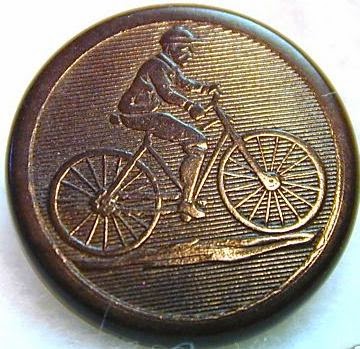
Pressed Vegetable Ivory.  It's common to see this small size button priced at over $50 if in Good condition!
Fortunately, the bicycle wasn't limited to just a man's sport and woman soon flocked to the streets on the tricycle and then the bicycle.  Suddenly, women could travel a distance away from home and the bicycle opened the door for women's freedom.  It is said that the bicycle greatly contributed to the success of the suffragette movement.

Stereoview card:  "SEW ON YOUR OWN BUTTONS, I'M GOING FOR A RIDE."

"Let me tell you what I think about bicycling. It has done more to emancipate women than anything else in this world. It gives her a feeling of self-reliance and independence the moment she takes her seat; and away she goes, the picture of untrammeled womanhood. I stand and rejoice every time I see a woman on a wheel . . ."  -- Suffragette Susan B. Anthony in a speech given on Feb 2, 1896 - quoted in the New York World newspaper


As the bicycle changed and improved, more women wanted to ride the two-wheel bicycles and this really required that their clothing allowed a bit more movement.  Women's skirts, corsets and undergarments soon followed suit allowing women to take to the road.  The idea of "proper attire" for women also started to change, and bloomers for women slowly became an acceptable part of fashion with pants soon following to put a foot *uh... LEG* in the door for freedom and personal choice when it came to women's fashion.


Clothing manufacturers soon added special suits, gloves, leggings, union suits for both men and women, boots and a special waist to be worn by women while riding.  Special jewelry, buckles, skirt lifters and buttons were also made.

The lovely pictorial Victorian buttons of the day also started to reflect the joy of bicycling for both men and women made of almost every material.  Clubs and Leagues sprang up quickly and the groups wore special cycling clothing with buttons made for their organizations.
Cycling outfits. 1894
IF you know what you're looking for, you can probably also easily find a uniform looking button with the letters LAW and spokes which belongs to the League of American Wheelmen.  This early uniform button was worn by bicycle enthusiasts, c. 1890 and has several version since.  The design is still used by the club today, though they now also refer to themselves as League of American Bicyclists. This button may be identified as some kind of Air Force or foreign Military button because of the wings (and tossed into a poke box) by those who don't know the relationship of the design. Look for them while poking around!
League of American Wheelmen clothing button.
This organization was founded May 30, 1880 in Newport, Rhode Island.
Watch for other similar bicycle club/league buttons as well, as they'll usually have some kind of spoke radiating out from the center and a raised edge or rim which is the tire and many have the letters of the club they represent.  Some may be rather plain, with just radiating spokes, only hinting at a bike wheel.  Many collectors and dealers don't recognize them, and you may get lucky and pull a few from a poke box!

Tricycle similar to that shown on the button.
More history on the Tricycle can be found at the Tricycle Museum website.

Bicycle buttons, both antique and modern can be found fairly easily, but the antique versions are more scarce due to those who also collect bicycle ephemera are scooping them up!


There are High Wheeler or Penny Farthing bicycle buttons that were a popular motif in 1950-70 and those modern buttons can usually be found for just a dollar (or less, so don't pay too much!).  They also come in several versions, including one with a rider.  The Steam Punk movement may have made these later versions more popular today, so buy one now if you don't have it.  There are older versions of the High Wheeler, Penny Farthing and even Bone Breakers to be found, and those have the typical tin backs found on most Div I buttons.


Modern Theodore Gates Glass Watch Crystal studio button - 1970.
Antique Tricycle Toy made from a 1970 US 6 cent stamp.
Toy velocipedes became the rage for children almost immediately.
Early "Safety" style bicycle.
"Paris Back" Metal.
Albert Parent Company.  Marked AP&Cie Paris

Woodstock riding a bicycle.  Plastic, c. 1960-70
Modern cold enameled metal
More about buttons picturing Bicycles can be found in the following National Button Society Bulletins:  
February 2005:  The February 2005 issue has a fabulous color section full of Bicycle buttons, one of which is similar, but definitely has the same design elements as my button (it appears to be a later French White version, see below).  It's a wonderfully done article with great photos.  Here's a sample of it:

Closeup from the NBS bulletin of the slightly different version of my button.
I think this is  a French White reproduction  c. 1940
Also see NBS issues:.
February 2005 - Velocipedes by Herman Bangeman Jr.
May 1986 - Looking at Bicycle Buttons
January-February 1974 - Several member's trays of creative mounting showing bicycle buttons, related early advertising and pin back buttons.  Very interesting!

If you have any other information on the Race of the Velocipedes button, have seen it in a book, article, for sale at a Button Show (or have one in a different style, tint or size), I'd love to hear from you!

AND, if you love buttons, please consider following this blog.  I promise I've got loads of more buttony goodness coming up soon!

Comments?  Suggestions?  Leave one!
Interested in collecting button?  Check out the National Button Society on line!
Thanks for reading... really!
Vicky
P.S.  I'll just leave this video here for you, go on... you know you want to take a RIDE:  https://www.youtube.com/watch?v=GugsCdLHm-Q


Tuesday, April 14, 2015

WOOTON Wood Buttons

WOOTON WOOD BUTTONS

**NEW! Updated 7-/24/2020 (previous update 4/25/2015)

I have kicked around doing an article about Wooton wood buttons for a while. Problem was, there isn't much known about them! Since the topic came up on Button Bytes, I thought I'd just kick it off here. 
Wooton Blue Bird - Heat Stamped.  
Courtesy of Mona Abrahamson
Thanks to Mona Abrahamson for bringing up this topic on Button Bytes (with the above and below pictured button) and to Gil Biggie who emailed me to remind me that we got to yacking about Wootons after I pulled one out of a Poke Box and shoved it in her face to look at during the Arizona show, LOL!  Gil asked me to share what I do/don’t know.  Well, it's mostly DON'T *grin*  


The original card that started the discussion - Blue Bird.  
Courtesy of Mona Abrahamson
Wooton wood slice buttons were one of the first sets of interesting buttons that I found on their original store card when I first started collecting a zillion years ago (okay, about 20 years ago).

I don’t know why, but I adore these buttons *shrugs* and they make for a fun thing to search for at a show.  About the time I think I've seen them all, a new one will pop up.
My cute and UNUSUAL SMALL SNOWMAN.  Heat Stamped.
The Wooton topic is also timely, as I’m reworking my collection by material, and JUST pulled out tons of wood buttons yesterday to start to work on.  All sitting in sorted piles, baggies and little boxes in my dining room as I type.
 
So many wood buttons, so little time.
For those that don’t know…Wooton buttons are made from slices of natural tree branch with the bark still on the edges.  They are usually decorated by a stamped hot brand design before being painted.  A metal heat brand stamp is usually used first, so the individual designs are all uniform/identical (they’re not hand decorated with a hot tool, so technically probably not pyrography, which literally means fire writing).  Colors used may have changed within the design scheme over time.

*additional info. added on 04-16-2015:  The Big Book of Buttons shows a different horse head on Plate 96, #13, page 254 (old version) and describes it as "A slice of cherry wood, including the bark.  The horse head was stamped with a hot iron, then tinted and painted.  There were several other designs made in the same style including a colorful bunch of cherries.  $2.00"


Four Leaf Clover - Photo courtesy of Phyllis Culp

I have a leaf that seems to have a slight impression stamped of the same design that is on the front of the button on the back side, but just barely, like it was an error.  Maybe the stamp was cold, or perhaps it didn't have paint on it?  Not sure.  None of the others I have show any sign of stamping on the backs like this.

LEAF FRONT (THIS VERSION ALSO HAS BEEN SEEN PAINTED BROWN)

LEAF BACK - ODDITY.
NOTE THE IDENTICAL SLIGHT IMPRESSION OF THE FRONT DESIGN, BUT NOT HOT STAMPED.

After the design is stamped, they are hand painted and then varnish applied over the paint (I have a few that show light varnish checkering over the paint).  

They seem to be usually painted in basic primary colors of red, blue, green, yellow, white, black, though some unusual colors may also be seen from time to time.  Because these are a natural wood, the sizes won't be uniform, but I have them in everything from small (Snowman) to extra Large (almost 2"), though most seem to be around the same size and the small buttons seem to be more scarce. 

I also have some that are identical designs but the designs are rendered smaller to accommodate a button of a smaller size (see Butterfly and Cherries button pairs below).
Wooton buttons that I happened to have on my table while working on wood yesterday.
There are quite a few different designs, so they’re fun to look for in poke boxes.  Horse/rider, at least two different Horse head designs, Acorn, Cherries, Leaf, Snowman (small), Cactus (extra large), Basket of Fruit/Veggies with leaves in the background, several birds, a Scotty Dog with red bow, painter’s pallet and a Butterfly are a few that come to mind that I have around here… somewhere.  

I also have a few with conventional designs that seem to be Wootons as well but I've never seen them on an original card to confirm it.

MY LATEST NEW WOOTON DISCOVERY THAT I JUST FOUND!
 LARGE BASKET OF FRUIT WITH LEAVES, 1-3/4"

ANGLE SHOWING EDGE/NATURAL BARK

BACK VIEW OF BASKET BUTTON
PROBABLY NOT WOOTON DUE TO WOOD TYPE AND DARK CENTER CORE.
Courtesy of Merry Jo Thoele
I have other painted wood branch buttons, but they aren't stamped in like the Wooton buttons and just don't seem to be painted in the same color schemes.  

There may have been other companies who copied their idea and style and at this point are probably best left to call "Wooton Types" until more on the original card can be identified or a sample card turns up.  

We may have to think of them as we do the Burwood/Syroco wood composition buttons.  It's nice to know who made them, but they can be categorized as a type, without knowing what company made which buttons.

You can find artists doing painted/pyrography/heat stamping on wood branch buttons today on Etsy and other craft sites.  
 
WOOTON CARD OF HORSE HEAD BUTTONS
Another different Horse head version.
Note the crazed/chipping varnish.
Courtesy of Claudia Chalmers. 

The following is original card shows NO HOT STAMPING.  An error?  An anomaly in their production?  Maybe Wooton had a fast track line of buttons that were quickly painted with line and dot designs?  Perhaps more of the hand painted natural wood slices (with bark) we see actually ARE Wooton buttons!  

Unstamped painted Posies.  Note that the 1st button has white paint, and the other 2 have yellow instead.
Courtesy of Joyce Bimbi.  

**NOTE: Claudia Chalmers also has this same original card of buttons which are not heat stamped either.
*Claudia Chalmers and Merry Jo Thoele of Minnesota have given me permission to add the buttons that they each collected about 10 years ago.  They were featured in an article Claudia wrote called The Cross Cut Branches for the Minnesota State Button Society bulletin. Some interesting versions of Wooton and types appear below and through this article with their permission. *added 04/25/2015

About ten years ago, Merry Jo Thoele and I entered into a friendly, informal competition.  Both of us having an interest in wood buttons, we decided to see what we could do with one of the simplest wood button types, the cross-cut branch.  There were a couple of lightly outlined rules: 1) There had to be bark on the outer rim to prove it was a branch and not a drilled disc;  2) The buttons had to be vintage and not modern studios.  We had great fun with this, and would recommend these informal competitions to other collectors.  It was, as Merry Jo put it, “ . . . fun  . . . because it is just between us - kind of a secret like best friends have. “  We were trying to beat each other to various dealers’ tables, having dealers search for and hide away buttons for us, bragging about our “finds” and sometimes the low price we paid for them (these buttons are usually very reasonably priced).  


Mushrooms in a Forrest.Courtesy of Claudia Chalmers
Flower Border in 3 colors.
NOTE:  HAS A DRILLED OUT SEW THROUGH HOLE.  WOOTON?
Courtesy of Claudia Chalmers
Pussy Willows.  Heat stamped.Courtesy of Claudia Chalmers
Painted Sailboat.  No stamp.Courtesy of Claudia Chalmers

Snowman with Pipe.  (Note, different design from my small Snowman button)
Courtesy of Claudia Chalmers

Unstamped (note wood species difference) Painted Umbrella.  Probably Wooton Type made by a different company/person.
courtesy of Claudia Chalmers
Unpainted, heat stamped Four-Leaf Clover (see painted version at beginning)
courtesy of Claudia Chalmers
Unstamped Red FlowerCourtesy of Claudia Chalmers
Unstamped TulipCourtesy of Claudia Chalmers
Hearts and Clovers.  Stamped.
Courtesy Merry Jo Thoele
Diagonal cut slice.  Probably not Wooton.  Mushrooms.  Not Stamped.
Courtesy of Merry Jo Thoele
Heat Stamped Stylized Flowers with multiple color centers.  Courtesy of Merry Jo Thoele
THREE ORANGES  Heat Stamped.Courtesy of Merry Jo Thoele
Three Objects - Tambourine, guitar and castanets.  Heat Stamped.Courtesy of Merry Jo Thoele
Okay, I have NO idea what this is supposed to be!  Heat Stampled?
 
Courtesy of Merry Jo Thoele

UNPAINTED MUSIC NOTES (MISSING FLOWERS)  Only heat stamped design.Courtesy of Merry Jo Thoele
PAINTED HEAT STAMPED VERSION OF ABOVE (WITH FLOWERS)
Courtesy of Claudia Chalmers
Painted without stamping. Courtesy of Merry Jo Thoele
Flourishes or a Letter?  Part of another design?  Heat stamped, no paint.  
 Courtesy of Merry Jo Thoele


Original Card Hearts & Clovers.  Heat Stamped.  Courtesy of Claudia Chalmers & Merry Jo Thoele.

There are no back marks of any kind found on any of my Wooton buttons.  If you don’t have the original card, you’d never know that Wooton was the company who made them.  It seems that the original cards haven’t ever been printed with the State/City that they were made at.  Although the card states Registered, without some kind of clue where the company was, it's nearly impossible to search for more information.
WOOTON CHERRY BUTTONS
 IMAGE RECENTLY TAKEN FROM THE INTERWEBS FOR MY OWN INFO PURPOSES, SO SORRY!  I CAN'T GIVE CREDIT FOR THIS ONE
I’m not sure of the dates either.  It’s my thinking (well, you know how THAT often goes) that these could have started to be made around the time of the Great Depression (branches would be a cheap/free material) and may have originally only been sold locally (where ever the maker was).  
HORSE AND RIDER
A hot stamped but unpainted version of the same Horse and Rider that is shown above it.
Photo courtesy of Merry Jo

Perhaps after some local success, they were marketed later to dime stores on printed cards with the company name during the 30’s or early 1940’s through the late 1950’s to maybe early 1960’s.  The green/brown design on the printed cards seem to fit that same period.

Hummingbird  Photo courtesy of Janet Gerhardt
They also would have fit right in during the time period when metal and other materials were limited to the War Effort for WW2 (1939-45 era).  

The only reference to them I've found so far in Button books/magazines is a small blurb mentioning the Cherries button in Hobbies Magazine (Vol 81, Issue 7, December, 1976):


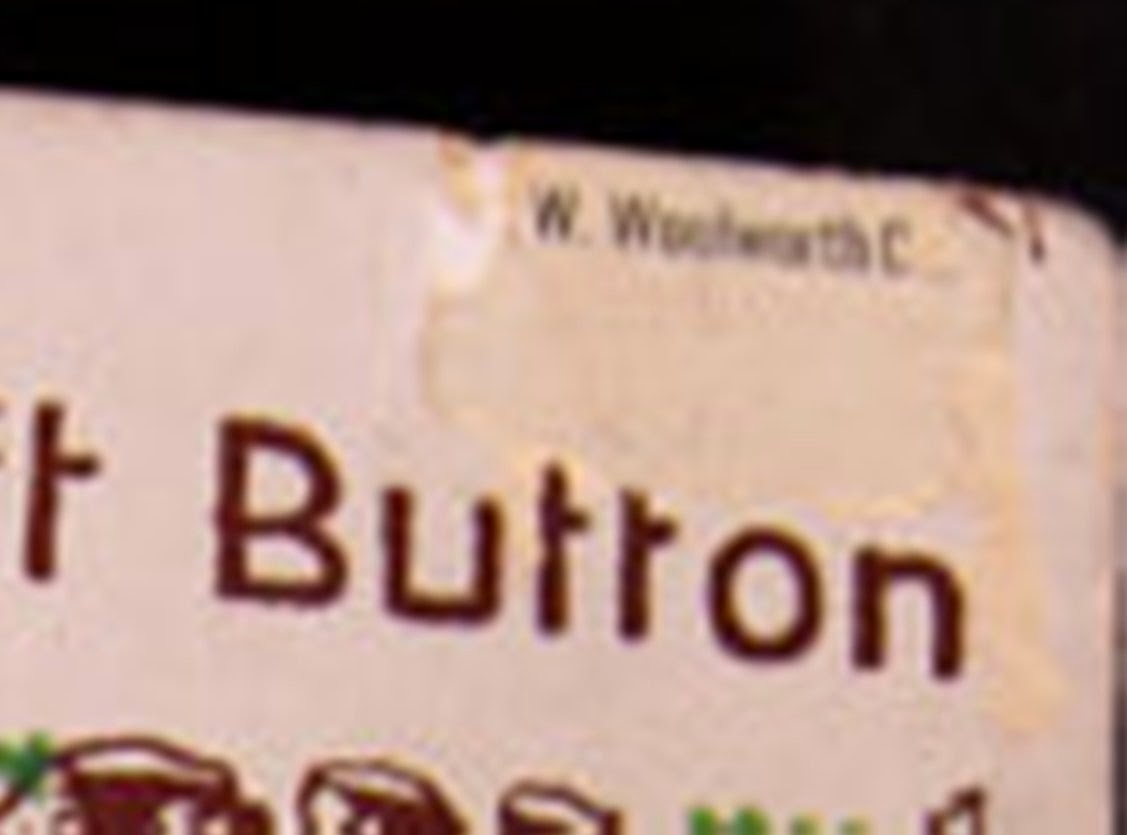
Recently I saw a Wooton card of the Cherries with a F.W. Woolworth’s price sticker on it (just a partial with the store name, no price) and I saved the photo.  Store price stickers could help to ID when they were sold for sure.  Woolworth’s had a solid 5 and 10 cent price limit until 1932 and 5-10-20 cent price line limit from 1932 through 1935 when they started to carry more items in more of a department store way.  Their WoolCo chains started in 1965.  Unfortunately, most resellers tend to take the original price tags off. L
 
PARTIAL F.W. WOOLWORTH CO. PRICE TAG
** UPDATE INFO 7/24/2020
These photos of an original card with a dated back were sent to me by Suzanne Whyte Munroe of Rhode Island. The Scottie card is dated July 19, 1944 on the back and has a price stamp of 25 cents!

Photos of dated Scottie Dog card
courtesy of Suzanne Whyte Munroe
of Rhode Island
Since the Big Book identifies it as Cherry Wood, maybe that can help with the place of origin or at least target Washington, Pennsylvania, West Virginia, Oregon, Michigan and California as starting places to look.

I plan to dig through my piles of printed info. in my file cabinet (ugh!) and find my boxes of saved original cards with the original buttons to see what I still have in the way of other original Wooton cards or if I have any the original company data or other clues that I tucked away over the years.  If I found out any information at one time, I’ve forgotten about aaaaall about it by now.  LOL

I'd like to thank everyone who has offered encouragement and participated with photographs of their Wooton and Wooton type buttons.  I hope to be able to continue to update this with new information as it shows up and show as many of the designs they made as possible.  If you have something to add, please contact me!

So...Check back here often, as I’ll add an update here for new examples of Wooton buttons as they come along and I'll also add anything that I find that can help to determine where and when they were made.  

Until then, I'll be chipping away at reorganizing my collection of wood buttons.
Working on Wood:  Burwood/Syroco, ANN/GAP and Masonite ready to go on new cards
And, if you like wood buttons, and have an interest in Wood Composition buttons, you can take a look at the article I did (waaay back in 2002) here:
http://www.iwantbuttons.com/education/vmwood/wood.htm

I'd love it if you would leave a comment, or suggestion. Have a new find? Send me a message at my paqe on Facebook (https://www.facebook.com/FlyingButtonRanch/)  I hope you'll follow me to receive notification on the next post on buttons!  Trust me... the next one will drive you crazy!
Cheers,
Vicky