Thursday, March 14, 2019


MOUNTING AND STORING YOUR BUTTON COLLECTION


Card of  Design Under Glass buttons
mounted on Matboard.
FLYING BUTTON RANCH COLLECTION.
So, you've started HOARDING (I mean COLLECTING) Antique and Vintage BUTTONS... For something so small, they can get out of control quickly! Right!? Boy, don't I know it sister!

Are you looking at jars, boxes and tins FULL of buttons? Ya think it's time to do something differently so you can REALLY enjoy your new collection and see what you have? YUP!! Well, you landed in the right spot today!
Boxes of buttons... gah! WHAT is in there?? 
Buttons really should be carded or stored on cards in order to protect them. Jars and tins (especially if sealed up) can cause all kinds of problems for buttons. Plastic buttons gas, rusty metal buttons causes havoc on everything, and it all is a deadly combination for all old buttons.
Jars and tins full of a mix of plastic, metals,
wood and other things (rusty nails, pins, etc.)
can cause SERIOUS problems quickly
for old buttons!
Get them out of there!!
Early button collectors would sew their buttons with thread to pieces of linen toweling, sew or attach buttons to old paper plates and cereal or cardboard box pieces. They also used old metal paper clips, rusty safety pins, pieces of leather cut in triangles (and shoved through the shank), pipe cleaner and all kinds of things to attach buttons. I’ve seen how these substandard fasteners and acidic fabric and paper pieces cause button damage (corrosion and off gassing). Baaaaaaaadddddddd! So remove the buttons as soon as you can.
Old early collection (c. 1940s)
sewn to a large piece of linen toweling.
Flying Button Ranch Collection.
China Button Collection
Sewn to an old paper plate c. 1940-60
Photo from Pinterest

Old button collection sewn to an old paper plate c. 1940-60
Photo from Pinterest

MOUNT THEM ON MATBOARD: The best card stock material to use are pieces of matboard (also called Crescent board) cut to 9 x 12 inch size. This size is also the standard NBS size when competing. Scraps in smaller sizes are fine for personal storage of your collection, so it's not a hard/fast rule for your own collection. 

Matboard in a rainbow of colors.
You also can find Matboard at hobby/craft stores in large sheets and cut them yourself or ask if they will cut them for you (usually for free). For example: Michael's craft store sells a standard sheet of 24” x 36” for $8.36 and get quite a few 9x12 pieces. Collectors generally use a 9"x12" size because that is what is used when submitting buttons for competition. You, however, get to choose what ever size you want. A 6 x 9" piece can store well also and smaller scrap sizes of board are easier to come by.
Look for sales and on-line coupons for framing shops and hobby/craft stores. It comes in a variety of colors and finishes (like flocked velvet, metallic, printed, etc.). You can also find better board in Acid Free types. Pick pretty colors to make a lovely wall display to complement the colors in your home! Stickers, stamps and postcards can also make a fun display with your buttons.

FREE IS BETTER: Various “scrap” sizes of matboard can be purchased fairly cheaply from art/picture framing shops (use Google to find one near you) and sometimes they’ll just give them to you FREE if you stop in each month and ask for them! 

That’s what I did for quite a while... stopping in a large framing shop and gallery each month and asking for the scraps. Sadly, when the generous owner passed away, his son decided to close the shop. When I asked him about the matboard, he asked me if I wanted it. Well, SURE. But how much? 

Well, he GAVE ME all the matboard in the shop that I could haul away in my truck if I wanted it! Yup, ALL. Free, gratis, for nada! Full sheets, scraps, TONS of pieces in colors, finishes and textures. CARDING HEAVEN! Of course, I took it ALL and I looked like the Clampett family moving when I LOADED my pickup truck (tied the mountainous pile down to the truck bed and put small pieces in the crew cab back seat because there was so much!) and drove out of there. LOL and so am set for life with matboard!
It's amazing what you can get in a TRUCK.
CUTTING MATBOARD: I use an extra large vintage wood guillotine paper cutter for the large sheets, and smaller ones for the 9x12 sizes (find them at resale shops! That's where I found all of mine.), but you can also use a sharp hobby knife and GOOD ruler. Cut the board to to 9 x 12 size pieces, but save the smaller pieces for miscellaneous button mountings. 
A vintage Guillotine Paper Cutter. Love these!!

TO DESIGN OR NOT TO DESIGN: A pretty layout is fun if you’re putting the buttons in competition or on the wall for display. Also, you can use fun postcards, stamps, paper scraps, etc. to make a fun and creative mounting! Get inspired on-line/Pinterest! 

If you don't know much about materials or age of your buttons NO WORRIES, mount them by color or pictorial (like all Dog buttons together). Just do what ever gives you A HAPPY.

Have FUN with your buttons and hobby! Lay-out the buttons as you think you’ll like them, mark the spots of each button on the matboard and use a Craft Circle Template around each mark. 

If you like the look of the circles, you can buy pre-made clear rigid plastic design templates. They're reusable and available through some dealers (like this page http://amazinglaserdesigns.com/button-mats-templates/and cost $8.50 each) 
and Button Images 
(she also sells almost every item a buttons collector needs and all the stuff I’m talking about in this article, and MORE). 
Oh yeah... Nope... I make nothing from the links above! Just tell them FBR sent you! *grin*

Button templates for mounting.
A selection from Amazing Laser Designs (see link above).
Also, some button clubs have all kinds of template designs to LOAN to members for FREE so it's worth joining up to one in your area for help with buttons and to answer your questions!!

Note: When mounting for competition, you’ll want to use a template to match the size/number of buttons required for the award, so keep that in mind when choosing templates!

PUNCHING HOLES: If a shank button, the shank is going to go through the board, you’ll want to use a METAL AWL or Scratch Awl to punch a good size hole to accommodate the shank, allowing the button to sit flat on the matboard.  
Scratch Awl for punching holes.
You can get an Awl in any hardware store (Home Depot) or look in your husband's/friends tool box. A friend of mine had her dad cut down a screwdriver really short for me and he ground the tip into a deadly sharp point. It's perfect (and yes, I've put it into my hand, fingers and leg a few times. Owwwch!).

If you are mounting a 2 or 4 hold sew through, the double spiked corn cob holders work great for putting 2 holes in a card and mounting those types of buttons flat. Use a wood cutting board with some Styrofoam or carpet over it to punch holes. Bend the wire in a U, Feed each end of the wires through each one of the 2 holes (only need to use 2 holes on a 4 hole button), twist the button wires together on the back of the card. Tah*Dah! A button is mounted!
CORN HOLDERS - Great way to make holes to
mount sew-through buttons!
(Insert CORNY pun spot HOLDER *here*)
FBR TIP FOR MAKING LOTS OF QUICK CARDS: If I just want make a bunch of standard matboards for storing certain types of buttons in my collection quickly (a work card, say of all red glass or all celluloid of a certain kind), I’ve used a dremel with a small DRILL BIT  to make holes. How many buttons I put on a card depends on the size of the buttons, so for a group of large buttons I may only drill 15 or 20 holes, while for my small glass buttons I may drill 40.  Here's how I do it:

I put a stack of 4-8 matboards together, draw the template for the hole spacing on top of the top matboard and clip all of them together with heavy duty binder clips or any good clamps. Then I just drill through them all (with a Dremel drill bit or small hand drill) and get quite a few done in one shot! 

I also just ordered a Dremel Drill Press from Amazon. I’m hoping it makes drilling holes in cards with my Dremel even easier! I’ll let you know!

(Flying Button Ranch is a participant in the Amazon Services LLC Associate Program. Links below provide a means for me to earn a small fee by linking products mentioned in my blog to Amazon.com, at no additional cost to you).

UPDATE: LOVE, LOVE, LOVE using this to drill through my cards! I either draw circles or place dots on the top card, and then clip 4 or 5 cards together with the binder clips and easily bring down the handle. Highly recommended (and if you have the Dremel to begin with, just getting this is super inexpensive). A BONUS with this? The drill press allows you to turn the Dremel sideways, and with a BUFFING PAD you can polish your buttons on it! YaY! You can find the DREMEL DRILL PRESS AT AMAZON.


FASTENING THE BUTTONS ON YOUR CARDS WITH WIRE

Buttons are mounted with PLASTIC COATED COPPER WIRE. Yup, the plastic-coated copper telephone and computer cable wire. I look for it at swap meets, thrift stores, Habitat for Humanity resale stores, etc. Be sure to check the wire BEFORE BUYING, as some is fiber optic wiring and it  won’t work for mounting buttons. If the wire is in a plastic cased cable, ask to cut off and inch or two of the plastic that holds all the wires together to check to make sure it's a bendable, will stay in a wound state (make a circle out of the end of a wire) and is a small bundle of wires inside of the plastic casing and not some weird fiber optic stuff.

I have MULTIPLE SPOOLS of old phone wire and cable wire saved up. I sit and cut a big Tupperware bowl full of pieces, using wire cutters so they're ready for carding anytime the mood strikes. That's not often. LOL

I encouraged a button friend to stop whenever she sees a telephone or cable company truck stopped and working and ASK them nicely for any wire scraps. Of course she got some... for FREE (and it could be because that when she told the guy that she collected buttons, he figured she was crazy and he just wanted her to go away. Ha ha!).

  
My spools of wire and cables of computer wire.
I have enough to last for YEARS and
enough to share with Button Friends!
KYNAR WIRE: A super thin tiny wire with a coating of Kynar, get the 30 AWG ( American Wire Gauge) size. It was available at Radio Shack a few years ago, but I don’t know about today. Most model train and craft stores should carry it. It works great for diminutives, antique buttons (whistle buttons) with tiny holes, etc. Worth searching out for a small supply to have on hand for those types of buttons. You can find it on Amazon… but shop for best price and watch for how much you get in a spool! The number at the end (K-30-1000) is the feet in the spool (usually 1,000). That should last a WHILE. Right? Here is what I bought (link to Amazon)  KYNAR WIRE ON AMAZON

30 AWG Kynar coated Wire.
Prefect for Whistle buttons and
Diminutives with tiny holes!
NOTE:  Early collectors used pipe cleaners and the rust on those old buttons/cards is a good clue that the use can cause damage to your buttons by moisture being absorbed by the pipe cleaner which causes it (and the buttons/shanks and button body or parts that's made of steel) to rust or the GREEN MEANIES (verdigris) to grow on brass and copper metals. It’s unknown if modern pipe cleaner is going to rust, so you really want to avoid that also. 

Other DO NOT use items are the metal button cotter pins (will rust), safety pins (may rust or cause interaction), and tooth picks through the shanks at the back of a mounting card (will hold moisture in humid environments). 

Metal cotter pins. Throw away!
Plastic cotter pins are okay to use though!

FRAMING YOUR BEAUTIFUL BUTTONS: After your buttons are mounted, you’ll want to either display them on your walls, or safely store at home. You also can cut the matboard to fit any size FRAME for display at home. Note: keep buttons out of sunlight!! Most hobby stores also sell SHADOW BOX COLLECTION FRAMES with a glass front in various sizes which work great for buttons. Again, look for them on sale, buy with coupons or look in the clearance section.

Shadow box wall frames come in
all different sizes and are great for
buttons, buckles and studs!

POLY PROTECTION BAGS: The plastic I like are a flat, zip top, 2-4 mil thick in a 10”x12” size. Gives a bit of room for the card of buttons (unframed) and easier to get in and out if you cut a card a tad big. These will keep your buttons from getting scratched, broken, falling out of the bag if it comes loose and other damage while stored in a box or cabinet. You'll want open top, and 4 mil thick bags to really protect them from sitting next to each other. The larger 10 x 12 size is hard to find, so I get the 9 x 12 and just cut my general storage cards a 1/4" smaller in width (8-3/4 x 12).  I use these:AMAZON 4 MIL OPEN TOP POLY BAGS . 200 bags for about $19 and a great price for 200 of them (and you can always split them with a button buddy!).

BANKER'S BOXES are a great way to store your buttons once they are CARDED AND each card is PROTECTED with a plastic poly bag. You can stack boxes in a corner, under a bed (use bed lifts), stack in a closet, or throw a cute scarf or table cloth over a stack to make it look like an end table or console table. LOL

Banker's Boxes are an inexpensive way
to store your precious button collection!

FILE CABINETS: Eventually, you’ll think about getting one. LOL I started with a small 2 drawer cabinet, moved to a large/tall LATERAL FILE CABINET and now have 4 lateral file cabinets and a combo drawer/single lateral file unit in my button room. Yeah… FOUR plus. *sigh*


5 DRAWER LATERAL FILE CABINET.
This was an old cabinet I purchased
when a hospital got rid of them. BARGAIN.

Cabinets in my current Button Room.
The 4-drawer cabinets were purchased on Craigslist
from a used office furniture seller. Great buy!
The little yellow metal drawers on the top
are for sorting buttons that need to be carded.
They came from a hardware store that
went out of business. Perfect!
SHOP/JOB TICKET HOLDERS are used for button competition if you belong to a Button Society. They're used to hang the button card entries on racks for viewing by the public at a BUTTON SHOW. They also serve to protect your buttons. A must have (and some states have banned the bulky clunky wood/glass drop in frames for competition, like Arizona did).

C-Line makes a nice Stitched Shop Ticket Holder, both sides are clear, 9 x 12 Inches in size and 25 per Box  for about $20 (I also get mine on Amazon). 9 x 12 SHOP TICKET HOLDERS ON AMAZON There are also some all clear made by Avery, about the same price. You should be able to get some from Office Supply stores or get them ordered there also. Go in with a buddy to reduce the cost and split the box!
Box of 25 shop ticket holders on Amazon.

A shop ticket holder holding
this fun creative card of mine!
This is a SERIES set by Marie-Christine Pavone
Well FBR Friends, that’s all for today. Leave comments if you think I missed something, if you have a question, or just to say HOWDY. Feel free to share a link to this blog on your FACEBOOK page if you think your new button collectors would benefit from this article. Thanks for reading! Come see me on Facebook where I post fun button facts and fun Button Memes daily at FLYING BUTTON RANCH! <3 FBR


Tuesday, January 15, 2019

Button Books: What to buy?


Some of my books in my button room.
When it comes to books, I have no SHELF control!

Button Books:  What to buy?

ISBN thinking about you... *grin* (yes, there will be book puns!) You know button collecting is terrific. We all start a button collection for various reasons. Some of us just are interested in the pictorial or design. Perhaps you just want to collect buttons, any and all!  To many button lovers, age and material doesn't matter. There isn't anything wrong with this method of collecting...Until you start to ask questions about what you have. 

So, you get on the computer, and look at photos of buttons... and try a zillion key words.  *ugh*  And if you're like me, you look like this:


So, you started collecting and (sooner or later) are ready to CHECK OUT because you want to know MORE. WHAT is that material? WHEN was it made? WHO wore that?  IS this one really a button? WHY is that picture on that button! WHY is this shank so different looking!!!? WHY do they call it THAT?

WHY is that (little, ugly, weird, etc.) button SO FREAKING EXPENSIVE!!?? 

WHYYYYY?  LOL

The first few years I collected, I didn't have much of an idea about the National Button Society nor button clubs.  Information on the internet was zippo... nada.  I was basically floating along on my own, hoarding all the buttons I could find at swap meets, antique shops and 2nd hand stores.  Then, my husband bought me my first button book while on a vacation celebrating our anniversary.  The book was About Buttons by Peggy Ann Osborne.

With just that one book, the switch was flipped and I was learning about these tiny treasures. It is still is my favorite book of all time, and one I recommend to any new collector.  The book is around $80.00 new, but IMHO, well worth the cost.  This book answered lots of questions and made me want to know even MORE, MORE, MORE!!  So, as I could, I added more button books (and got myself to go see a button club).

Today I'll share a few favorites in my Button reference library with you, and give you my take on what's great about the books, what I feel is a must have, what you can live without (or at least wait until you find it at a bargain price).

The #1 spot is tied.  There are 2 books that I have dog eared, fallen asleep with and would chase someone down with my pointy button awl to get them back:

#1a:  ABOUT BUTTONS: A Collector's Guide, 150 A.D. to the Present.  Peggy Ann Osborne, 1994.  320 pages, colored illustrations.  I ADORE this book.  My copy is worn and tattered and I slept with it for months after buying it.  It takes you through various periods and explains the buttons that were worn at the time, along with slices of history and beautiful photos.  All books have errors, it's BOUND to happen, but this one is pretty on the money.  If I had to pick only one button book, this one would be it.


Closely followed by...

#1b:  Big Book of Buttons (BBB):  Hughes-Lester; First Edition (June 1981)  813 pages. Called the Button Bible by collectors, this book separates buttons out by material and then by pictorials.  I have my face in this book at least twice a week. While it's difficult to look up buttons in to identify something, if you read this book from cover to cover, you'll get a good grasp on how the National Button Society classifies buttons and you'll be seeing terrific buttons and some decent identifications. The BBB 1st edition has identification errors, and went out of print.  The old editions can be terribly pricey, as high as $500!!  Crazy!

The BBB was updated and reprinted in 2011 into 2 volumes (which makes it easier to read/handle) and was updated some. It sells for $375.00 plus $18.00 shipping.  I'm not sure it's worth it, so... if you can find an old copy of the BBB for $100-$250, I'd recommend to buy it (and use that extra $$$ for buttons!)!  You can always sell the old version for what you paid for it if you decide to buy this new updated version. If you love the old pictorial metal buttons, and want to know what the identifications/names were that they generally go by, then you really will want this book. I like big books and I cannot lie.

#2 The Collector's Encyclopedia of Buttons, Sally Luscomb.  242 Pages, 1968.  A forgotten older book, however, packed with lots of information.  Revised in 2007 and includes a price guide (ignore that) .  A great book to curl up with and absorb all the great information and button lingo/jargon. 

#3 National Button Society Classification Booklets:  Well, this isn't actually a book, but more like a booklet... and there are several that you should have.  Start off with that I really (REALLY) think you should join NBS, if only for the booklets and on line searches available to you through ALL of the NBS bulletins that were digitized and made searchable by keywords.  You can read all of the old bulletins starting from 1945 onward.  I LOVE their website for that reason, and I use their booklets constantly. 
Well worth the $35.00 yearly membership since you get all the access AND five (5) issues of the National Button Bulletin which is in color (fabulous every issue!) along with the Classification "Blue" Book with information on classifying buttons and also competing (if you wish to eventually do so).  
With membership, you can also purchase numbers 4, 5, 6 and 7 below:

#4 Black Glass Classification
(just updated by Joan Lindsay and Simone Kincaid, 64 pages and 800 color photos, and it's WONDERFUL!!)  $25.00 A must have for a new collector since black glass is one material you'll amass a ton of quickly!!  Great photos, information on both the old (Division I) and modern (Division III) buttons. Available on the NBS website (link above and below).


#5 Clear and Colored Glass Classification by Jane Ford Adams and revised by Jean Longo.  Revised in 2002, with wonderful information and color photos, 30 pages, $8.00.  Again, glass is going to flow into your collection quickly, so you might as well get this great booklet to get a handle on old and new glass.  Terrific photograph and lots of information which tells you about the old (Division I) and modern (Division III) buttons.  In color. Available on the NBS website (links below).


#6 Pearl and Shell Button Classification by Margaret Kelso and updated by Shirley Case in 2002.  Shell is wonderful and this is also a great 26 page booklet packed with photos and information.  $8.00.  Available on the NBS website (links below).


#7 National Button Society Section 9-A Synthetic Polymers by Jocelyn Howells and Nikki Deal  A complete study of all Plastics (except Celluloid).  A must have booklet!  Color photos and everything you need to know about those hard to identify and confusing plastics.  You'll be a pro at sorting Polyester from Nylon in no time! A BARGAIN at $5.00! Available on the NBS website (links below).


#8 Button Materials A-Z: Identification Guide, Jocelyn Howells.  $55 includes shipping. Everything you'll need to figure out what a button is made of. Order direct from the author buttonjoss@frontier.com 


Now, there are 100's of other button books. Some out of print, but can be had dirt cheap on eBay, Amazon and book sites like Abe Books. 

IMHO, the following books are also worth having. So, Check your shelf before you wreck your shelf.. Do some comparison shopping first, and get these super, mostly inexpensive books for the great photos, info and just a good book to sit with:

Buttons: The Collector's Guide to Selecting, Restoring, and Enjoying New and Vintage Buttons; Courage Books, 1994 by Fink & Ditzler

Baubles, Buttons and Beads The Heritage of Bohemia; Schiffer, 1997 by Jargstrorf, S.  Super information on the early Bohemian/Czech button industry with beautiful pictorial examples of Beads, Buttons and Jewelry (what's not to like!?).

Button, Button: Identification and Price Guide: Identification and Price Guide; Schiffer, 2000 by Peggy Ann Osborne. I truly adore this author's books! See my #1 books above.  And by the same author... Fun Buttons; Schiffer, 1994 by Peggy Ann Osborne. I spotted one on eBay for less $8!! 


Antique and Collectible Buttons: Identification and Values; Collector Books, 1997 and Antique and Collectible Buttons: Identification and Values, Volume II; Collector Books, 2002 - both by Debra Wisniewski. Fun buttons that most new collectors can easily find.

Buttons by Epstein & Safro; Harry Abrams, 1991. Hardcover, 175 pages, color (don't get the tiny book!). A Gorgeous book filled with rare and wonderful buttons.

Now, if you would rather spend your money at button shows, eBay and ETSY *grin*, you can always BOOK it over to your local library! Also, join a local button club! They usually have a lending library and you might also get a free button mentor/button buddy just for hanging out with them! 

And if you're wondering how many button books there are (including crafting with buttons, military, written in other countries/foreign language, uniform, etc.) there are book lists at several websites you can use to look at button books that may also feed your button soul:

WESTERN REGIONAL BUTTON ASSOCIATION BUTTON BOOKS BY TOPIC

BUTTON IMAGES BOOK LIST

NATIONAL BUTTON SOCIETY STORE (no, I don't make any money on links!) You can purchase several of the booklets listed above here AND join NBS!

Thanks for reading today! I hope you'll follow my blog (yes, I've been neglectful!) as I have plans to do all kinds of fun and informative button posts soon!  I hope you'll follow the FBR blog and leave me a comment!

ALSO be sure to wander over to my FLYING BUTTON RANCH facebook page! I post there a few times a week. Lots of fun stuff going on there also (so be sure to Like and FOLLOW the page)!
I hope you've had a GOOD READ here and that these book puns have tickled your SPINE. Okay! I'm done!!
Happy Reading and Buttoning!


Thursday, December 17, 2015

BEETLE MANIA

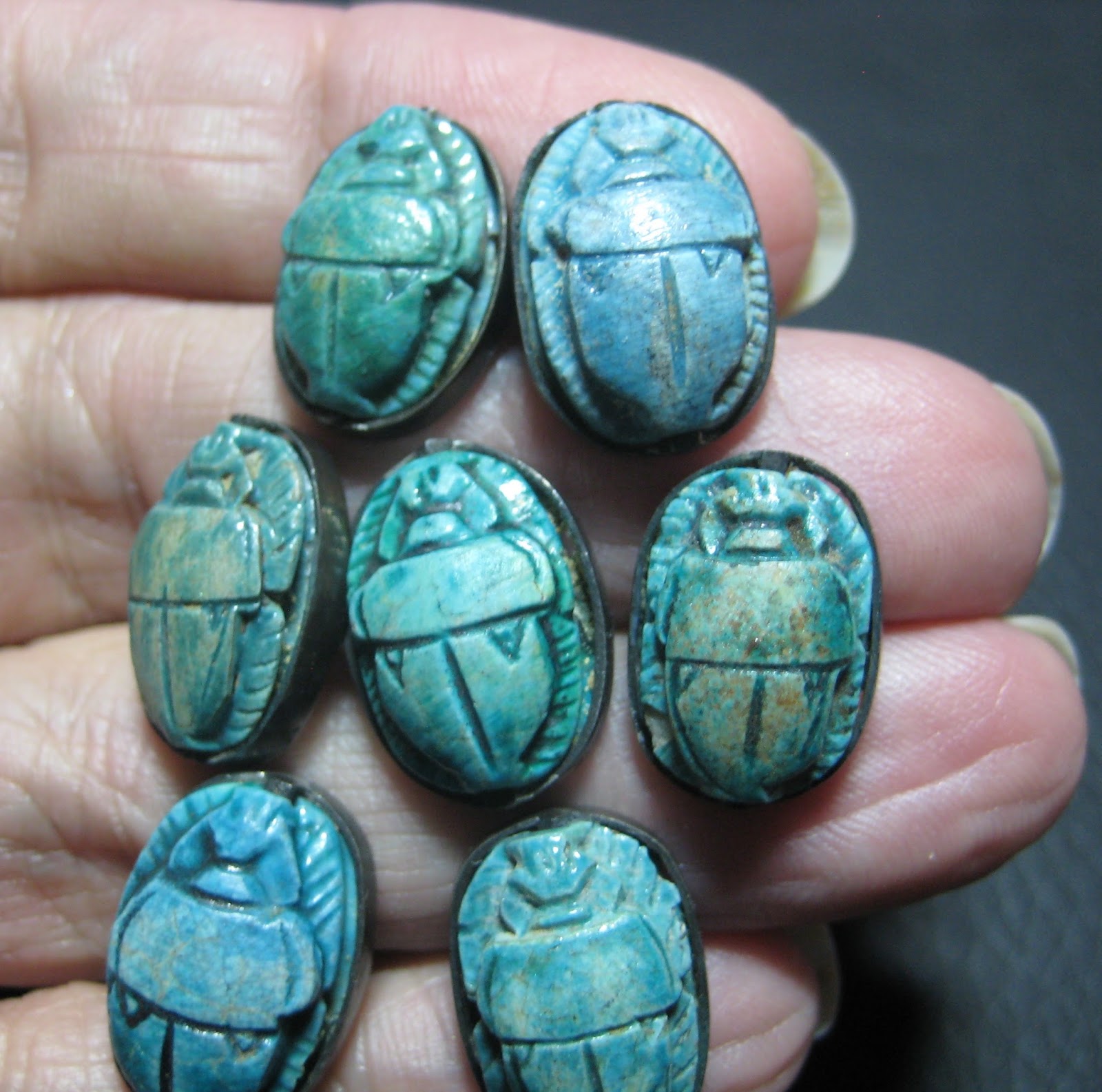
These buttons are KHEPERS (keepers)! *grin*
Meet the Beetles!  
These sweet little lovelies are Egyptian SCARAB BEETLES and are mounted in silver. What a great find at the antique show I went to last Saturday! I calmly and politely bargained for them. I put on a poker face, trying my best to act uninterested... seeming ready to pass them back and walk away (never!!) as I made a final offer...and was victorious.  

Yes, I admit it... I did a little happy button dance walking away from that table clutching my prize! My husband acted like he didn't know me for 5 minutes. LOL


They are a Dung Beetle, which is an ARTHROPOD and scarab comes from the taxonomic family name, Scarabaeidae.  This video about blew my mind... pretty interesting if you have an interest in these bugs!

These odd beetles spend their days flying around (yes, they have wings!) searching out piles, forming and rolling balls of dung backwards with their hind legs.  Yeah... doodie, poop, number 2!! The dung is not only their food source, but they will roll the ball to put under ground in a burrow where it then lays an egg in it, which keeps the egg warm due to composting action. 
Mom!  Herman isn't playing ball with meeeeeeee!
The egg incubates in the warm crib of caca known as a brood ball, hatches and then the single offspring eats it while in larvae form until ready to molt and emerge from the nest, fully formed and ready to fly away to carry on the tradition. 

"Hey kids! Dinner's ready. I don't care what you think it tastes like! Just eat it.!"   I should remind my husband about the dung beetle next time he complains about having to eat leftovers.  At least it's not the same **** every day.  haha... 

BEETLE MANIA


An Egyptian Scarab beetle is also known as a Kheper, which is an Egyptian PUN (and we all know how I love a good pun!). 

The Egyptian word kheprer means both scarab and "to exist or become" and to the ancient Egyptians, the strange insect was associated with word the due to their other worldly sudden appearance out of the earth. 

The beetles were worshiped by the Egyptians and became an important symbolic figure of creation and resurrection akin to the cross and its symbolic meaning for Christians, Almost everyone wore the symbol of the scarab in one form or another as an amulet worn around the neck on a cord or string or tied to the wrist or a finger.  

The scarab beetle was often depicted with a sun overhead since like the sun, the beetles appeared and disappeared each day. They also believed the dung beetle kept the Earth revolving just like a giant ball of dung they rolled underground, linking the insect to Khepri, the Egyptian god of the rising sun who was believed to control the movement of the sun.

The Egyptian god Khepri, (also derived from the same word Kheprer) was considered the god of the sun, creation, life and resurrection and like the scarab, like the scarab, he was believed to also be self-existing (appeared on his own and not created by anyone or anything).  

He is usually is depicted as a human with a scarab beetle on his head or with the head of a scarab beetle. Like the scarab, Khepri was believed to push or roll the sun along the sky each day, just as the Scarab pushes along his "special" cargo and food.  The little beetles do in fact, follow the sun for guidance in navigation to their burrow.  

The scarab was used as an important Egyptian symbol before 2000 BCE and continued well beyond the the last Pharaoh ruling Egypt.

Hmmm, a bug and a guy with a bug head who have coprophagia (your FBR word of the day... gah!) and then you want to become a big fan boy of that guy and the bug? The early Egyptians weren't the sharpest crayons in the box I think.  LOL

THIS OLD BUG

When you thinks of Egypt, the pyramids, sphinxes, mummies, and the scarab amulet are probably the first objects that come to mind.  Okay, and maybe the movie Raiders of the Lost Ark and Indiana Jones flashed in mine for a second or two and to be honest, the Bangles song Walk Like An Egyptian song became a brain worm for a day. DOH!  *shrugs*

The scarab has been collected for centuries, with the most interest for them starting in the nineteenth and early twentieth centuries as drawings of the wonders of Egypt started to appear after the first European explorers reported their findings.  Before the 19th century, travel from Europe to Egypt was difficult and almost unheard of. In 1799 Napoleon's expedition drew attention to the treasures of Egypt.  Exploration of 1845-45 and documentation started the desire for all things Egyptian and the Egyptian Grand Tour era was born.

Archaeological and antique Egyptian treasures were both a popular tourist item and the small scarab amulet pieces were brought back or imported in order to sell to collectors and were often incorporated into jewelry (and occasionally buttons and studs). Egyptian design became highly popular all through the 19th century when the first Egyptian Grand Tour era was in full swing during the late-Victorian era.  Many antiquities, but especially small scarabs, were brought back from Egypt because they were so plentiful back then.

The interest in all things from Egypt really ramped up again when in 1891 British archaeologist Howard Carter started searching Egypt again, even though most of the ancient Egyptian tombs had been discovered.  

The little-known King Tutankhamen, who had died at the age of 18, was still unaccounted for and shortly after World War I Carter started an intensive search for King Tut’s Tomb. On November 26, 1922 he and a fellow archaeologist (Lord Carnarvon) found and entered the amazingly intact tomb. The interest in the story and news of the found treasures greatly and quickly influenced design. Jewelers such as Cartier, incorporated faience, scarabs and other Egyptian made pieces in fine pieces of Egyptian inspired jewelry around that same time.
Scarabs have fascinated the amateur collector for well over a century.  Interest in the little amulets in beetle form heightened when in 1917 W.F.M. Petrie published a now classic guide which is most often referred to by collectors.  Scarabs and Cylinders with Names not only has become the reference for scarab collectors, but also by those who wish to deceive collectors and use it to produce forgeries. 

There are scarabs which bear the names of kings, the royal family and names of officials, of which are carefully and artfully carved on the reverse in both raised or intaglio carved hieroglyphs.  Much in the same way that coins show the changes in a civilization, the reverse of a scarab can provide a method of dating them and applying their historical place in Egypt.

THE BUTTONS

When I saw and purchased the buttons, I just assumed them to be a glazed ceramic or Egyptian faience. Faience is an odd material, and is made from sintered finely crushed silica (a finely crushed quartz), plant ash and copper oxide.
Back view of silver shank.  The bar connecting the bezel obscures the carving on the bottom.
It isn't really a pottery, but is the earliest known NON-CLAY ceramic composition (similar to Prosser china buttons in a way). It was a precursor to glazed clay-based ceramics, such as earthenware and stoneware, and also to glass (which wasn't invented until around 3500 BCE). It was made to mimic precious stone (lapis and turquoise) and can be found in a wide range of shades of turquoise, blue and green, though the oldest found usually has a glaze that has mostly turned to a brown color. Water was mixed with the crushed paste mixture to make it moldable and as it dried, the water and alkali migrated to the top of the piece, bringing with it the copper oxides which self glazes the piece as it is fired and creates a vitreous hardened surface as the alkali fuses with the quartz and copper. 
ANCIENT FAIENCE HIPPO WITH BROKEN LEGS WHICH SHOWS THE QUARTZ PASTE BODY
Tuesday I started off what would become a looooong day doing research on Egyptian scarabs. I figured I was on the right track ROLLING IT around in my head *grin*, that all scarabs were made of Egyptian Faience. Right?
An ancient molded faience Scarab

W R O N G
*SIGH*
While there are faience scarabs, everything started to indicate that the buttons I found were made of glazed carved STEATITE (a mineral talc occurring in a consolidated form, or as it's more commonly known as SOAPSTONE) once I started reading about the history of the scarab.

Both the earliest Egyptian scarabs (antiquities, beginning around 2040 - 1786 BCE ) and modern antique scarabs were carved from steatite and then they were glazed with copper or cobalt based glazes that were fluxed with plant ash and fired to give them their beautiful glossy blue and green colors and also fuses with the steatite and creates a hardened surface in the same manner that the glaze did on faience material.   

Glazed mineral or stone!?  Wow.  Well, I certainly learned something new!  I didn't even know that glazing a mineral was even possible!!
Range of colors in the set of buttons.  So pretty!
One clue that you have steatite is that you won't see fine sharp molded details (as with a ceramic or glass) and when you have a set, it's easy to see that they all are carved just a bit different. 


The glaze makes it difficult to identify just what the material is made of (and I was only about 80% sure about these being glazed soapstone by this time). So to be SURE... I emailed an expert who is a collector of early Egyptian Scarabs and seals who lives in Germany. 

I told him that they were in a (tarnished) silver setting, and that the scarabs were each drilled at each long end. There was a sharp point from the silver bezel setting holding the scarab cab in the setting by being inserted into the holes at each end.

I also told him that I thought they were probably soapstone/steatite, and that I figured they were put in the silver settings during the Egyptian Revival period, around 1920, though I had no idea of the age of the scarabs themselves.  I also said that I would value his time and opinion since I wanted to write about these, and wanted to provide correct information for anyone who would care to read about them, and also so I could categorize the material and age correctly in my collection.  I offered to send photos as an email attachment if he cared to see them.  He replied fairly quickly and told me to send photo attachments.  

This was is reply late yesterday:

Hi Vicky,

Thanks for your Email and the pics. I think you are perfectly correct with a date around 1920. They are not antique in terms of archaeology but certainly older than 50 years in my opinion.

They look as if they are coming from the same workshop or even were made by the same hand. However the stuff coming from modern workshops in Egypt does not reach this quality.

Material seems to be glazed steatite and at least on one example I can see a stylized Amun-Re inscription with flanking Neb signs (=lord) so the inscriptions seem to make sense, which nowadays is not always the case. The shape is inspired by 19th Dynasty scarabs (roughly 1300-1200 B.C.) They were probably made when Egyptology reached it's height of popularity in the 20s or 30s. Older examples from the 19th century are known as "Grand Tour scarabs" These are sometimes hard to distinguish from the originals. Authentic Grand tour scarabs are carefully made, often glazed and mostly have a readable inscription, often copied from illustrations in Petrie or Newberry. You can find examples on the internet but the term is often used to sell modern forgeries especially on ebay. 

For a button collector your scarabs must be very interesting, thanks for sharing them

Best Wishes and Merry Christmas
Olaf
(if you'd like to have a look at his website and pieces from his collection, it's really fascinating! )

So there we have it!  Not ancient antiquities, however the scarabs older than the settings, and they're glazed steatite.  The markings he noted on the back of each scarab are interesting, but unfortunately, the setting blocks viewing them for the most part.

Olaf also sent me a link to a scarab from the last century BCE which was in a setting from the Victorian period to show me the difference between a true scarab antiquity brought in during the Egyptian Grand Tour and set into jewelry to compare with I have. The very early scarabs are very finely carved and finished.  He warned me though, that there are many forgeries of these out there that mimic these ancient scarabs. You can see the lovely piece here:

Modern scarabs, especially those in the last 50-80 years which are imported for jewelry, beading or crafting usually aren't hard to distinguish.  They are a bit boxy rather than oval and the top is flatter (rather than rounded top shell).  Details, especially the head and legs just aren't carved well on most of these. 
Modern scarabs sometimes sold as old.
A BUTTON SCARAB as called by scarab collectors, is actually a SCARAB AMULET. They LOOK like a button fastener, but are NOT.  They were also worn, suspended by a drilled hole through a formed hump area on the bottom of the scarab and a thread or cord was threaded into the hole and it was tied on as a necklace, on a wrist or finger. Many of these amulets found today are fakes, made to look like the ancient ones in order to deceive scarab collectors, and may pop up in button collections or for sale as a button once in a while. 
AMULET CALLED BUTTON SCARAB.  BACK VIEW.  NOT A BUTTON!!

ANOTHER BUTTON SCARAB AMULET
Resist buying those with these "self shanks" that are thick and usually have lined carving on them. One of these was mentioned in the NBS bulletin Sept. 1955 as a button, in a collection.  Ugh! A bonus though, if a true antiquity (and not a later forgery) it could be worth a bundle of money!!

When a scarab cab is set in metal or has more of a typical button style self or inserted metal shank, you can be assured that it was meant to be used as a button.

Keep a look out for a lovely real beetle shell set in metal button also! It's NOT a scarab (as sellers like to identify it as), but a Brazilian or Ecuadorian beetle known as a Cassidinae or TORTOISE BEETLE from the Chrysamelid family. It's a leaf beetle with a beautiful iridescent shell that makes for a wonderful button, just not as scarab beetle example!
Photo from Pinterest
Scarabs have had several eras of design popularity and when one shows up on a button, pricing on them usually is stiff, so snap up bargains quickly! 

A set of six jeweled gold-mounted Nephrite scarab buttons marked Fabergé, Moscow, 1899-1908.
Sold at Christies auction for $50,602.00
Fun group of scarab and Egyptian theme buttons found on Pinterest, noted as sold on eBay for $124.95.
They're always a popular pictorial for button collectors and it would take a while to put together a whole varied tray of them because they aren't terribly common, especially Division I scarab examples! Both Division I and Division III (modern) eras have scarab pictorials in a variety of materials such as ceramic, plaster, carved stone and gemstone, glass, enameled metal and modern plastics. There are also a few fabulous metal scarab buttons to be found. 

Scarabs, beetles and other bugs are fun to search for on buttons and are probably one of my favorite pictorials (next to Dogs). 

I was pretty happy to be able to bring these guys home AND it was a birthday gift to myself.  I'm tellin' ya...on the way home from the antique show, I could hear all 7 of the little beetle buttons singing "Crappy Birthday toooo Yoooouuuuuu!" from inside the bag, I swear it!!
.   

Wishing you and yours a Merry Christmas and a buggy button New Year from myself and Luna the Wonder Chihuahua here at Flying Button Ranch.

FBR xx