Today I'm posting about GEMMA KAHNG – and her nifty 90's vintage VANITY LOGO BUTTONS.
This may be one of those buttons that makes people go HMMMMMM in the future, but now YOU (my favorite FBR Friend) will know just WHO she belongs to when you spot one!
 |
| SIGNATURE TRADEMARK WOMAN WEARING A BEEHIVE HAT, SUNGLASSES AND EARRINGS Flying Button Ranch Collection |
This LARGE and heavy deluxe button features the 90s haute couture designer Gemma Kahng’s trademarked logo. Her once ubiquitous fashion logo came about when she was 35. The then fledgling fashion designer was looking to garner some brand attention… So she dreamt up the fun logo of a boxy shouldered woman wearing sunglasses, earrings and a big beehive hat. Is it a self portrait of Ms. Kahng? I honestly don't know... I've not yet been able to find any kind of quote from her that says it was.
The now iconic logo, appears on at least two different buttons and inside on the label of her garments. It was also printed on her fabric totes, T-shirts, jewelry and other items.
 |
| Patent and Trademark Office September 25, 1990 |

 |
| Label found inside all of her pieces. |


 |
| Shank. No back mark to indicate the designer. |

The button I have, and am showing today once lived on what once was a $1,790 leather jacket designed by Kahng in the 1990s.

 |
| Luxury Leather with BIG heavy metal buttons. Yummy! |

Her designs had unexpected colorful accents and often incorporated large button-like trims (2 shanks) on pockets.


Gemma obviously loved buttons! The buttons on many of Kahng’s pieces are almost as whimsical as those of Schiaparelli. It has been noted that Schiaparelli is Kahng's soulmate in fashion history. Schiaparelli created a tailored style that was classic and timeless, yet sprinkled with surprising and sometimes shocking details. Kahng's pieces gave off that same vibe, classic yet fabulously slightly askew. Who doesn't love wearing something once in a while that is noticeable and notable. Both women's surviving pieces are amazing, memorable and... COLLECTIBLE.
Clearly Kahng’s pieces were made for the successful woman. At Bergdorf Goodman in 1991, the retail price for a Jacket with large flower jewel buttons was $785 and $220 for a slim skirt.
 |
| 1990s Gemma Kahng |
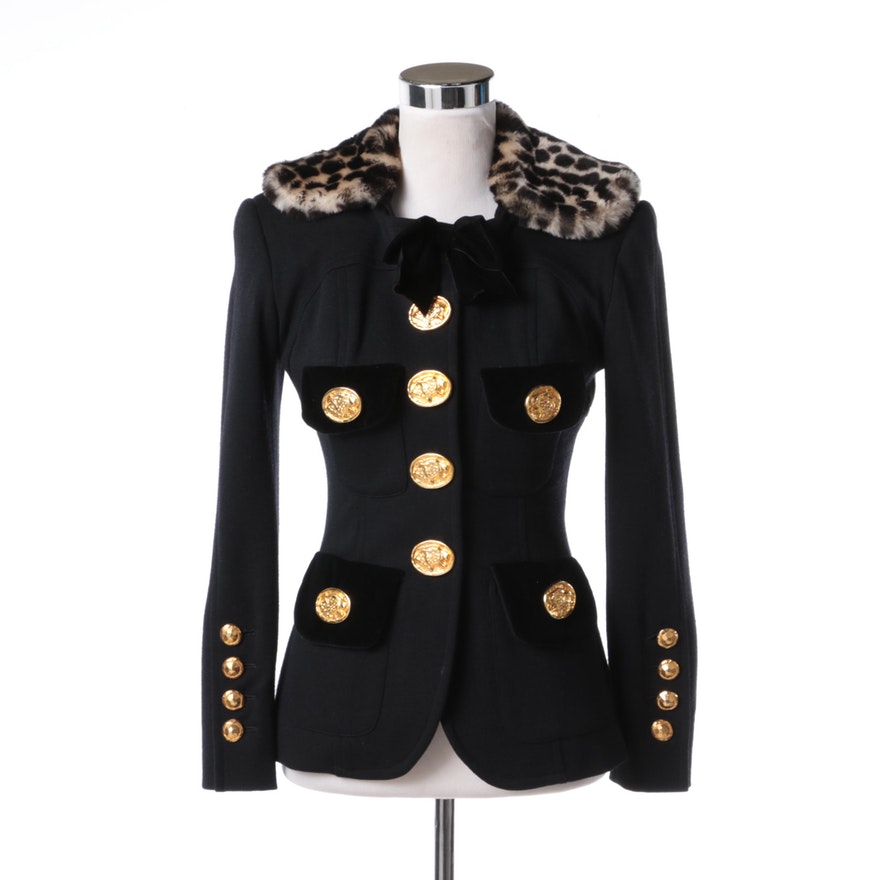 |
| Jacket with large Leopard head buttons (see close-up below) |

 |
| Glass jewels set in metal buttons |


 |
| Faux Tortoiseshell plastic hearts |
 |
| Fabric covered buttons ala Matisse |
Born in 1954 and raised in Masan, South Korea, Gemma grew up wearing clothing that her mother made for her and her sister and they learned embroidery and sewing from her. Her father, a mechanical engineering professor, was invited to teach at a school in Michigan when Kahng was 14 and the family moved to the US. She said that because she didn’t speak English, she loved art class (since she didn’t have to try to communicate much) and it was in this class that she discovered her calling. After high school, she attended the Art Institute of Chicago and in her second year decided to focus on fashion.
 |
| Gemma Kahng |
After graduating from the Art Institute, she moved to New York City and quickly landed a job with Korean designer Cathy Hardwick as her assistant designing modern sportswear for four years. In 1984, Kahng married high end designer Charles Chang-Lima (who had his own well-respected design line, though Charles went bankrupt in 2009 following their divorce).
SUCCESS OF THE 90S:
After leaving Hardwick’s, she freelanced for a while and decided to try launching her own label in 1989. With the $35,000 that her parents had given to her as a down payment on an apartment, she took a risk and created her first collection, which debuted at the Art Institute of Chicago that same year. Thirty retailers picked up her debut line. Kahng moved into her her sister’s Salt Lake City’s home basement as her workroom to keep up with the demand.
 |
| Cabbage Rose Buttons - lovely! |


 |
| The famous BOW often topped with buttons or trims. Ya know what they say... BOWS before HOSE. (OKAY, I'll stop). |
 |
| Whimsical fabrics featuring Gemma's animal art and fun big buttons. |
 |
| Looks to be a polished Buffalo Horn button. |
 |
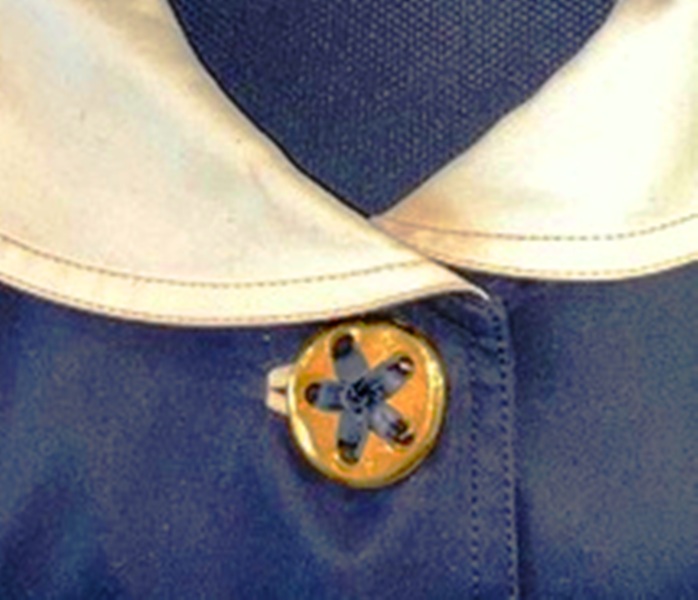
| A metal button with ribbon "stitched" detailing. |
Quirky, yet stylish enough for cutting edge fashionistas, her designs instantly became wildly popular. Two years later, her success allowed her to hire staff and to move her business to Seventh Avenue in New York City.
Sharon Stone appeared in Vogue wearing her designs. Who can forget Madonna in the infamous Vanity Fair photo shoot in 1992 where she sported an a$$-less lavender body suit made by Kahng (see Photo). Just wow... LOL
 |
| OMG Madge… 😂 LOL |
In 1991, she was doing so well (reported to have been making $6 million per year) that she moved her four-person operation to 550 Seventh Avenue. Her signature jackets with large and interesting buttons, pantsuits and whimsical garments were snapped up by buyers for their chic sense of kitsch and humor. You could find Gemma Kahng in most of the high-end stores. If you shopped Neiman Marcus, Bergdorf Goodman or Bloomingdale’s for your power suits, Kahng’s designs were found on the racks with hefty price tags, hanging next to brands like Chanel and Prada.
 |
| Christy Turlington wearing a Gemma Kahng logo T-shirt and belt on the cover of Vogue 1990 |
 |
| Logo belt buckle! These ARE also back marked with her name. (spotted on eBay). |
 |
| Back mark on buckles. Why do designers not make cardboard belts? Because it would be a WAIST of paper! *runs out of the room* |
 |
| Another fun Gemma Kahng buckle. Sparkle! Oooooh. At $200 (with missing rhinestones)? I'll pass on adding this vintage goodie to my buckle collection for now. (Spotted on eBay) |
During those 9 years, the once substantial orders from large retailers waned and the interest from the fashion world stopped. The all important fashion news media and magazines stopped coming to view her collections and her name became a shadow of her former brand recognition.
In 1999, Ms. Kahng gave up the 7th Avenue studio and took up a 500-square-foot space within a costume shop that she discovered on Craigslist. She did freelance design for a Japanese company, and took out loans against her SoHo apartment to finance her living and brand expenses. She tried venturing into the children's market and also helped design the costumes and sets for fellow Korean American Margaret Cho's acclaimed one-woman performance piece. She said “People didn’t realize I was nearly starving and living on the edge, I had great shoes and an optimistic personality.”
The 2000s were no better for her. Her designs disappeared from stores. It was at that small space in the costume shop that she had an encounter that gave her a brief 2nd life in fashion. While waiting outside of the shop’s restroom, she bumped into Joe Zee who told her about a new show concept called All On The Line (Sundance Channel) where he would counsel budding and failing designers. The producer invited her to participate in the first season and it aired in April 2011. On the program, Ms. Kahng shared “The older buyers who used to buy my clothes don’t have time for me anymore.”
Taking advantage of her celebrity on the show, she decided to try and rebrand, recognizing that she needed to become relevant again. After taking council from Joe Zee to lead with a more sophisticated and elegant style, a short rebirth in 2012 began with her new line. The buyers picked up the label and some money came in. Perhaps her fashion followers missed the quirky twists and funky touches her fashion used to have, and sales were slow. Sadly, the "come back" didn’t last but a few years, and soon she decided to leave the fashion business behind her.
The only racks filled with the once thriving brand are now found in the closets of fashion collectors and in vintage and resale shops. Today you can still find evidence of Kahng’s glory days in the pre-worn remains of power suits, pantsuits, jackets with squared off shoulders and tweed on 2nd hand sites like eBay, Etsy and Poshmark.
Gemma Kahng’s departure from fashion returned her to her original passion for art. She founded an art gallery in Hudson Valley in 2019 called the Beekman Arts Club. Today, Gemma lives and paints in Hopewell Junction. Her interest and subjects are birds and other animals which she describes as featuring the ‘fashion in nature’ of the beauty found in different species. I took a peek at her Facebook page, and gallery website… honestly, it’s all quite sad. Big pictures of birds in hats or wearing big pink dresses (at $3,000 no less)? Ooooh sweetie, please come back to painting a beautiful picture with your fun fashion designs and BUTTONS!
So just WHAT is considered a Designer VANITY BUTTON?
According to the NATIONAL BUTTON SOCIETY'S Classification Book, Vanity Buttons are buttons with a name, initial or logo of an individual, company, noted personality or retail store. They are listed under Section 25 - Usage - Class 25-3 DESIGNER (Vanity). Here are a few (from my collection or Pinterest as noted):
 |
| CARTIER Gilt plated metal (via Pinterest) |
 |
| FERRAGAMO Plastic with their iconic shoes. Can be found in metal and several logos. |
 |
| LANVIN Unless you know the logo, would you know the buttons if they just appeared in a poke box? Study those designer logos for bargains! (via Pinterest) |
 |
| MARC JACOBS An extra-large deluxe under lens cat button by Marc Jacobs featuring Rue the Cat c 2013. Designed for him by artist Tabboo (and signed at the bottom). Super rare. Yup in my collection. (and if you must have one, contact me on my Facebook page! I actually have a few duplicates!). |
 |
| RALPH LAUREN Natural Buffalo Horn with Metal logo escutcheon. |
 |
| SERGIO VALENTE Leather with logo and initials (1970-90s) |
 |
| My tray of Designer buttons that I entered in 2020 (I pushed it with a Monique Ogier button and *buzzer noise* I was given a "Measle" and disqualified. The NBS definition doesn't define Designer and frankly is poorly defined for competition... sooooo I push when frustrated. LOL Rebel without much of a clue. ¯\_(ツ)_/¯ (Arizona State Button Society). |
My Gemma Kahng logo button is not back marked, so as far as I know, none of her Buttons will be.
Really ONLY THOSE WITH HER LOGO (or with a back mark, if they exist) will be seriously considered a Vanity button connected to Gemma Kahng. When you think about it, fashion buttons weren't generally made just for just one designer unless it was their brand logo or had their name on the back! Some of these large non-logo buttons used by Kahng were probably sold to other fashion houses (especially after the designer went out of business and left fashion). Logo buttons are expensive for designers... When it comes to trimmings, fashion designers may not be conservative, but they are rather CLOTHES minded. *evil pun grin*
 |
| The only other version of her logo buttons that I've seen. |
 |
| Another version of her logo button. It looks to be most likely a cold plastic enamel decorative finish on metal. I wonder if this one has a back mark!? If I find one, I'll update here. |
Even though her early old(er) style pieces are still fairly expensive (a Kahng jacket with ho-hum buttons can run $100 to $500+), bargains can be had! Keep an eye peeled for resale shop bargains on-line and local vintage shops in your area. Stained/damaged jackets or those missing a button (or two) will usually be a good deal and you never know when you'll run across a single button deal (like I did!) on eBay or Etsy. The seller didn't have a clue that it was a designer button!
Here’s to hoping that her buttons are eventually going to find their way into button collections and on re-purposed jewelry creations (and hey... be creative, but leave the shanks alone and intact!). While not all of her buttons will be considered collectible or a Designer/Vanity button, they'll be fun to identify as used by Kahng for future collectors. Learn about them and buy them while you can! I am!
Thanks for reading! I hope you enjoyed this as much as I did researching this fun button and Gemma Kahng's history in fashion! Feel free to leave me a comment here AND/OR VISIT MY FLYING BUTTON RANCH FACEBOOK PAGE to comment. For more fun button history posts, give my Facebook FBR page a follow! <3 FBR


